
Last week, Japan issued its first-ever warning about the risk of a super-earthquake around the Nankai Trench running along the Pacific coast, prompting Prime Minister Kishida Fumio to cancel his planned trip to Asia and thousands of others to cancel their travel plans.
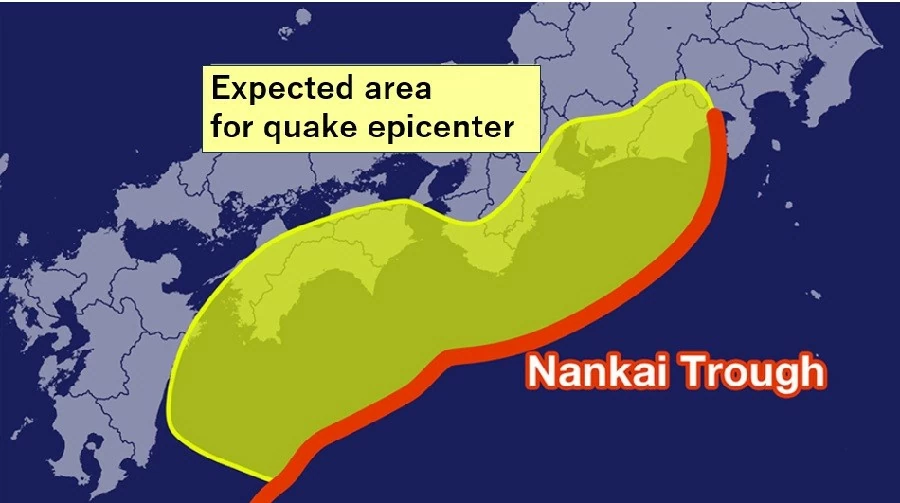 |
| Japan is on high alert following warnings of a potential mega-earthquake this week. (Source: NHK) |
This warning was issued by the Japan Meteorological Agency (JMA) on August 8, hours after a 7.1 magnitude earthquake struck off the coast of Miyazaki Prefecture, on the western edge of the Nankai Trench, shaking southwestern Japan.
Why is there a mega-earthquake warning?
JMA predicts that a mega-earthquake with a hypothetical epicenter in the Nankai Trough poses a relatively higher risk than normal, not limited to the area surrounding this earthquake but potentially extending to the entire Nankai Trough region.
According to the JMA, in a worst-case scenario, a strong earthquake could shake a vast area of Japan, from the Kanto region, centered around Tokyo, to the southwestern Kyushu region, and high tsunamis could occur along the Pacific coast from the Kanto region to Okinawa.
In January, the Japanese government 's Earthquake Research Committee predicted a 70-80% chance of an earthquake of magnitude 8-9 occurring near the Nankai Trench within the next 30 years.
After assessing the latest earthquake off the coast of Miyazaki Prefecture, the head of the committee, Naoshi Hirata, stated that the likelihood of a major earthquake along the Nankai Trench has now increased "many times."
However, he could not accurately predict which areas needed disaster preparedness, but urged everyone to be cautious about any unforeseen circumstances.
According to the JMA, the risk of a mega-earthquake could occur sometime within a week of the warning being issued.
Japanese Prime Minister Kishida Fumio has decided to cancel his planned visit to Central Asian countries Kazakhstan, Uzbekistan, and Mongolia, scheduled for August 9-12, in order to focus on directing the response to the potential for a major earthquake.
The leader also urged people to be prepared for the possibility of another earthquake.
Japan is urgently preparing for the response.
Japanese earthquake scientists have warned the country to prepare for a potential "super-earthquake" that could strike someday and kill hundreds of thousands of people, but they stressed that this warning does not mean a major earthquake is imminent.
With its geographical location along the "Pacific Ring of Fire," one of the world's most active tectonic belts for earthquakes, Japan frequently experiences earthquakes and even tsunamis, and the Land of the Rising Sun never ignores the risks of these disasters.
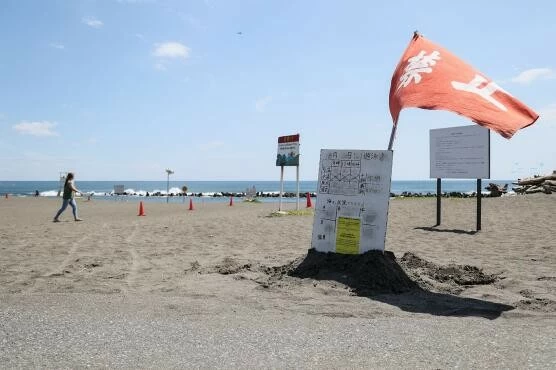 |
| A warning was issued advising people not to swim at a beach in Hiratsuka on August 10. (Source: AFP) |
Following the JMA's warning, residents in Japan's coastal prefectures stepped up preparations for a potential super-earthquake, including establishing safe evacuation routes, inspecting and repairing the physical conditions at shelters, and setting up dozens of additional evacuation sites.
| With its geographical location along the "Pacific Ring of Fire," one of the world's most active tectonic belts for earthquakes, Japan frequently experiences earthquakes and even tsunamis. |
In Kochi Prefecture, western Japan, a super-earthquake scenario could be followed by tsunamis as high as 34 meters, potentially striking the town of Kuroshio. Therefore, local authorities have urged the elderly and those with mobility issues to proactively seek safer locations during this time.
Emergency response forces are on alert 24/7.
Despite careful preparations for disaster response, the Japanese government is urging citizens not to hoard excessive amounts of emergency disaster kits.
The Japanese Ministry of Agriculture, Forestry and Fisheries shared a guideline on social media, urging people not to hoard food but recommending that they only buy slightly more than usual each day, use up the purchased food, and then replenish their reserves.
The appeal was made because some items had run out due to a surge in demand after authorities warned of the risk of a super-earthquake.



On online shopping sites like Amazon and Rakuten Group, items such as drinking water, portable emergency toilets, and canned food quickly became bestsellers, with some even selling out completely.
The demand for water, emergency kit bags, and products to prevent items from falling over has also increased significantly, especially in central Japan, one of the areas at high risk of major earthquakes.
Supermarkets have been forced to limit sales to no more than 12 two-liter bottles of drinking water per family to prevent hoarding.
The JMA's warning also led thousands of people to cancel hotel reservations in areas identified as high-risk, significantly impacting the revenue of companies, as this coincided with the start of the Obon holiday, one of Japan's longest holidays in August, from August 13-16.
In Kochi, at least 9,400 people have canceled hotel reservations since the JMA issued the alert, causing losses of approximately 140 million Yen (US$948,000).
Source: https://baoquocte.vn/nhat-ban-lan-dau-tien-canh-bao-ve-nguy-co-sieu-dong-dat-vi-sao-lai-xay-ra-dieu-nay-282537.html