
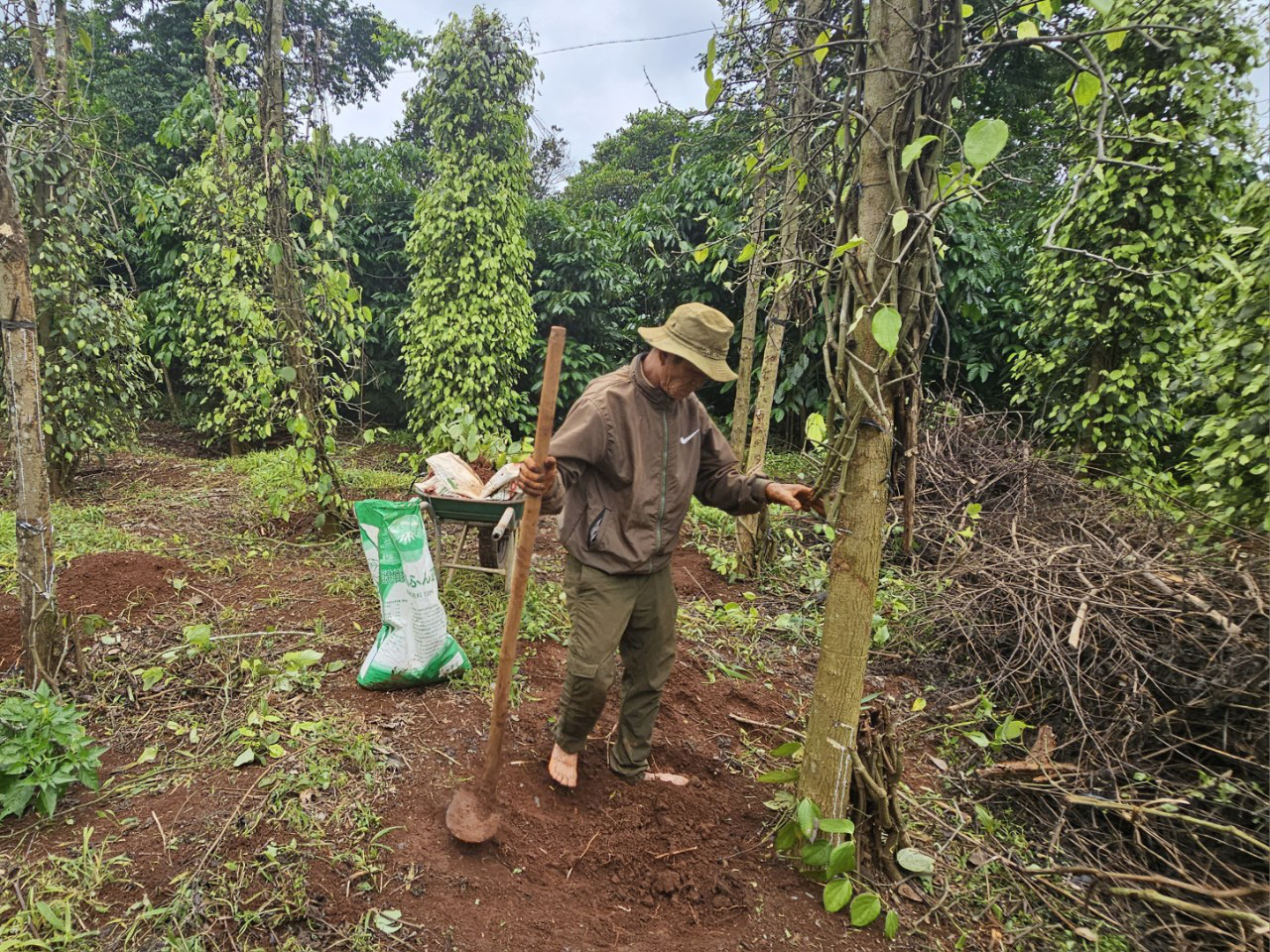
Many farmers have started planting new pepper plants, but the supply of this commodity remains low - Photo: N.TRÍ
According to surveys and information from many farmers and businesses, on July 7-8, pepper prices in some key growing regions of the country such as the Central Highlands and Southeast Vietnam continued to face downward pressure, falling by 1,000-4,000 VND/kg compared to a few days earlier. This has brought the average pepper price in the domestic market down, currently fluctuating around 136,000-140,000 VND/kg.
Specifically, in the Central Highlands region, today's pepper prices in Dak Lak decreased by 2,000 VND/kg, to a common price of 139,000 VND/kg. Pepper prices in Gia Lai and Dak Nong decreased by 1,000-2,000 VND/kg, to a common price of 138,000-140,000 VND/kg.
In the Southeast region, today's pepper prices in Ba Ria - Vung Tau , Dong Nai, and Binh Phuoc decreased by 3,000-4,000 VND/kg, falling to 136,000-138,000 VND/kg depending on the area and type of pepper.
Thus, after peaking at over 200,000 VND/kg in early June 2024, pepper prices have continuously declined and are currently at their lowest level in many months. However, compared to the low prices at the same time last year, current pepper prices are 55,000-60,000 VND/kg higher.
According to the Vietnam Pepper and Spice Association (VPSA), in recent months, major customers such as the US, Europe, and India have significantly increased their purchases of Vietnamese pepper, while China's purchases have decreased sharply.
Specifically, in the first six months of 2024, China fell from its number one position to fifth place on the list of Vietnam's largest pepper exporting countries, with a volume of 7,451 tons (compared to 55,000 tons in 2023), valued at $20 million, a sharp decrease of 85.2% in volume and 81.7% in value compared to the same period last year. China's market share also narrowed to 5.2% from 33% in the same period the previous year.
In a recent interview with Tuoi Tre Online , Ms. Hoang Thi Lien, chairwoman of VPSA, stated that the sharp increase in purchases last year, resulting in full warehouses, may have led to a decrease in demand in the Chinese market this year. Furthermore, the Chinese economy is currently facing difficulties.
However, Ms. Lien believes that the decline in pepper prices both globally and domestically is not solely due to reduced purchases by China, but may also be due to an increase in short-term supply as farmers sell off their produce during periods of high prices (May-June).
"Now, for prices to rise, there needs to be market momentum, there needs to be demand. The US and Europe account for nearly 50% of Vietnam's exports and have been buying very strongly in the first six months of the year. If these two markets don't buy much in the remaining months of the year, prices may struggle to rebound strongly as before," Ms. Lien commented.
However, according to Ms. Lien, even though Indonesia and Brazil will enter their harvest season, followed by Vietnam, pepper prices are unlikely to fall much further because the global supply is still insufficient to meet demand.



Sharing this view, many experts believe that the current supply of pepper is still low, especially in Vietnam (which supplies 40-50% of the world's pepper) and has not yet been able to increase it significantly.
"The supply of pepper cannot be abundant, at least for the next 2-3 years, because the planted area has continuously decreased in recent years, while people have not planted much new pepper. If they do plant new pepper, it will take 3 years to harvest," a representative of an export company commented.
Source: https://tuoitre.vn/trung-quoc-it-an-khien-gia-ho-tieu-giam-lien-tuc-20240807163900472.htm