
Special mission…
+ I recall that in 2019, the Vietnam Press Museum was tasked with coordinating with agencies in Thai Nguyen province to complete the dossier for delineating the historical site, a first step towards applying for National Monument recognition. Five years later, it was again assigned the role of investor for the restoration and preservation project of the Huynh Thuc Khang Journalism School National Monument… How did the Museum respond to this special task, Madam?
- It is indeed a special task. It originated in late 2023, when the Vietnam Journalists Association nominated the Vietnam Press Museum as the investor, and Thai Nguyen province approved the Project for the Restoration and Preservation of the National Monument of the Huynh Thuc Khang School of Journalism, unanimously selecting the Vietnam Press Museum as the investor.
As an "amateur" unit in implementing projects, especially those related to the restoration and preservation of heritage, the Vietnam Press Museum, with its previous experience from 2017-2019 (when it was the investor for the Vietnam Press Museum Exhibition, inaugurated in June 2020), had to make a great effort in the face of new and challenging tasks. According to the Heritage Law, the locality where a historical site is located is the investor and manager. The Museum is honored to be entrusted by the Association's leadership and Thai Nguyen province to coordinate with local departments and agencies to carry out this meaningful project. This is both a source of pride and a challenge, demanding a very high level of responsibility.
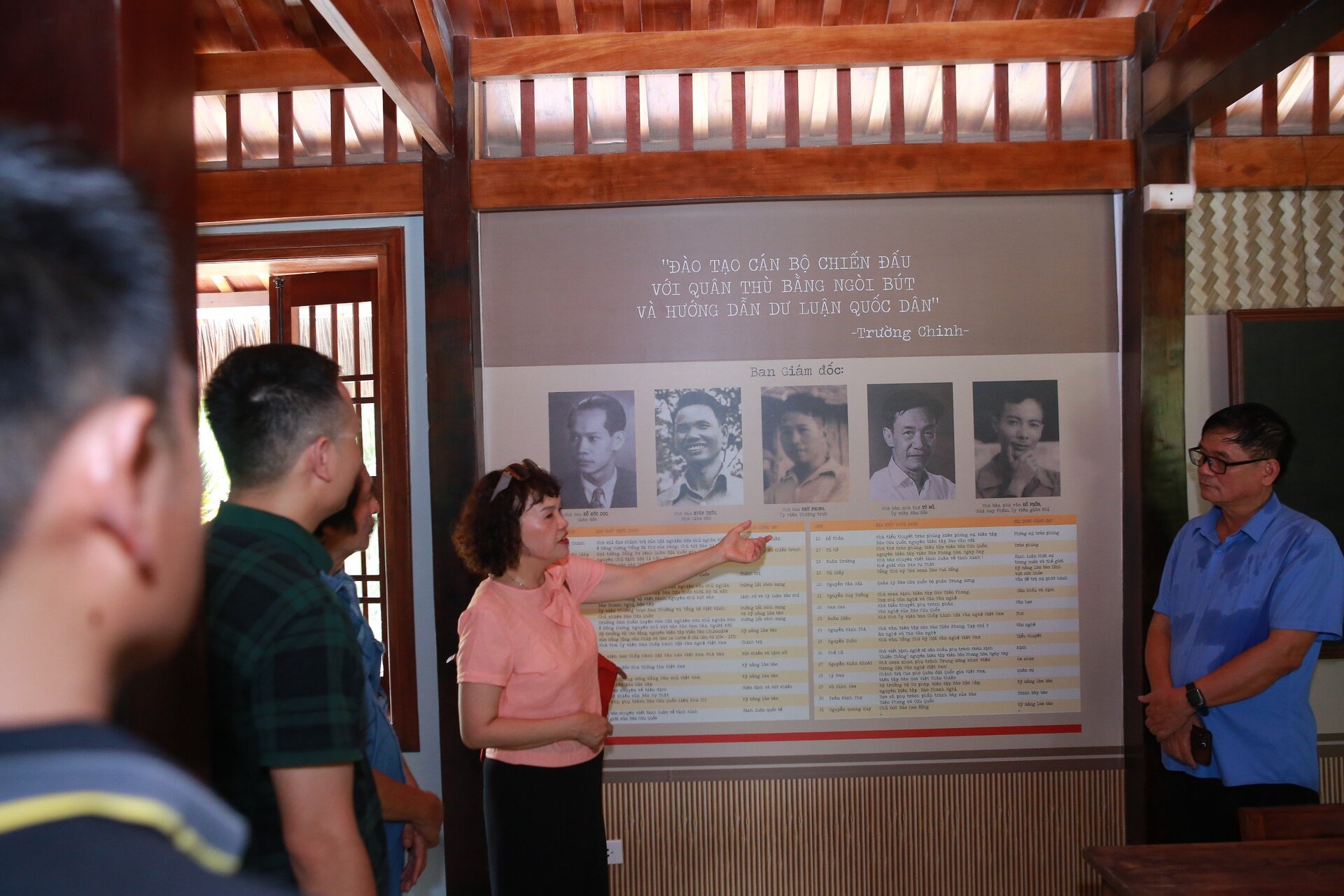
Journalist Tran Thi Kim Hoa, in charge of the Vietnam Press Museum, introduces the Board of Directors of the Huynh Thuc Khang School of Journalism. Photo: Quang Hung.
+ Given such a special task, and with limited staff, how did the Museum manage to successfully complete it, ensuring the building took shape just in time for the autumn season in August, Madam?
- It was indeed an extremely arduous journey. Initially, I only thought my job was to plan, coordinate, and urge contractors and construction units to carry out the tasks, realizing the form and content of the exhibition area of the historical site in a way that was aesthetically pleasing, true to the original idea, and had depth of content.
But then I realized that the work of a developer includes administrative procedures from land surveying, land allocation, and construction permits, involving many fields from environment, land administration, construction, to culture, transportation, electricity and water... The unpredictable weather, the geographical distance from Hanoi to Thai Nguyen, the time schedule, and even having to deal with so many "unprecedented" things, but we always kept in mind that for the common good, we had to complete the task, maintaining our mindset and unity to achieve the best possible result.
Nearly seven months after the groundbreaking ceremony, the project has now been completed on schedule. Ultimately, I believe the most important factor was the trust, support, and close supervision of the leaders of the Vietnam Journalists Association, the leaders of Thai Nguyen province, Dai Tu district, and Tan Thai commune… which enabled us to overcome even the most difficult challenges. Seeing the project improve day by day, the cold, rain, wind, and sun… are just “minor issues,” and other pressures seem to have vanished, leaving behind an invaluable sense of pride!
Recreating a "miniature museum" about the press in the Viet Bac war zone.
+ Pride is indeed a shared feeling among journalists nationwide right now. Madam, what are the special features of the Huynh Thuc Khang Journalism School National Historical Monument that has been inaugurated and handed over?
- First of all, it must be said that if the local authorities were to directly undertake this, they would certainly have their own approach. And for us, building a memorial house for the press is something no one can do better than the journalists themselves, because they know exactly what the house contains and what it needs. Therefore, the Press Museum voluntarily and willingly undertook this challenging task, and fortunately, became the project's investor, being allowed to implement and complete the work in its own way with the available materials.
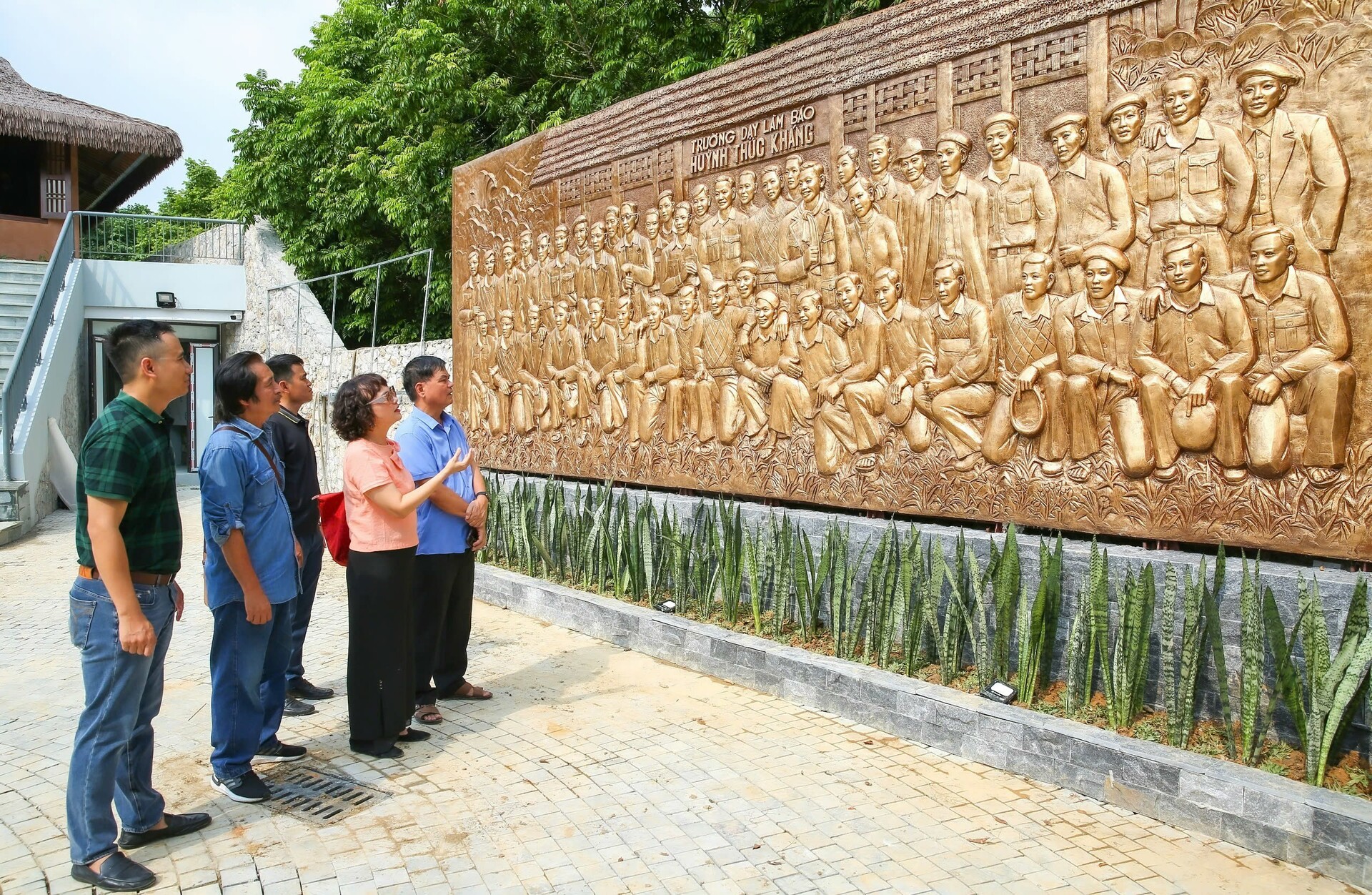
The bas-relief featuring 48 portraits of the school's Board of Directors, faculty, and students is an impressive highlight at the historical site. Photo: Son Hai
First, we had to find a skilled person to bring it to life on the drawing board, namely the renowned architect Huynh Thuc Hao – a man deeply committed to and with extensive experience and achievements in Northern Vietnamese rural architecture. Then, we found a carpenter with decades of experience building stilt houses in Bac Kan who came to the site to directly handle the woodwork. It was literally a case of "a stilt house builder making a stilt house," not an architect drawing and building a stilt house. The 80 m² stilt house, with numerous windows and walls maximized for display, includes display cabinets, large artifacts, and a rotating roller mechanism, offering ample storage for documents related to resistance journalism and Huynh Thuc Khang's publications.
Right within the grounds stands a magnificent bas-relief featuring 48 portraits of the school's Board of Directors, faculty, and students, sketched by artist Ngo Xuan Khoi and sculpted by sculptor Pham Sinh and his students. Then there's an auditorium nestled in the hillside, designed for conferences, seminars, and other activities, with a capacity of over 150 people; and a 200-square-meter "mini-square" that can be used for events and cultural performances... Every brick, every thatched roof, every coat of paint... was meticulously crafted with the goal of creating a beautiful building with cultural value and a lifespan of 50 to 70 years.
+ The Huynh Thuc Khang School of Journalism, after 70 years, has been officially recognized as a National Monument, and after 75 years, it possesses a diverse and vibrant "complex." Madam, recreating the space of resistance journalism and Huynh Thuc Khang journalism after more than seven decades, while simultaneously summarizing an entire period and exploring the depth of a school that only existed for three months, must have required tremendous effort from those assigned the task?
- For us, this is quite advantageous because the Vietnam Press Museum already has regular and thematic exhibitions on journalism in the Viet Bac war zone with many valuable documents. In addition to the existing documents and artifacts, we have researched, supplemented, and exploited some more suitable materials so that visitors will not only see the wood, roof, columns, etc., but more importantly, will see the atmosphere of the journalists, the atmosphere of the resistance war, and more proud images and stories about the first cradle of journalism training in the country…
At the exhibition area showcasing the Viet Bac War Zone Press 1946-1954, there is a map marking the locations of major newspapers and printing houses that converged in the former war zone. It can be said that, to create something more than just an architectural structure, and to infuse it with the spirit and values of journalism, a cultural space for journalism, and a vibrant glimpse into the life of the resistance, we had to put in double or triple the effort to create a miniature "museum" of the Viet Bac War Zone press as mentioned. The goal was for viewers to not only understand the Huynh Thuc Khang School of Journalism but also to gain a deeper understanding of the magnificent resistance war and a broader historical context beyond the scope of a single school...


It should also be added that, with its beautiful location at the gateway to the Ho Nui Coc Tourist Area, the Monument, after its restoration and renovation, has been and will continue to work in coordination with the local authorities and relevant agencies to make it a highlight in the list of tourist attractions, to be exploited, promoted, and widely introduced to people of all ages, both domestically and internationally, befitting its status as one of the invaluable journalistic cultural heritages of the history of Vietnamese Revolutionary Journalism, which generations of journalists in our country have strived to create and leave for today and tomorrow.
Most recently, we signed a cooperation agreement to organize the program "Media, Practical Experience: History and Heritage of Vietnamese Revolutionary Journalism" with the Management Board of the Huynh Thuc Khang National Historical Site of the Journalism School, the People's Committee of Tan Thai Commune, and Nhi Van Media Joint Stock Company. This can be considered a good start towards this goal.
Thank you, journalist!
Ha Van (Editor)
Source: https://www.congluan.vn/thach-thuc-va-tu-hao-post306791.html