
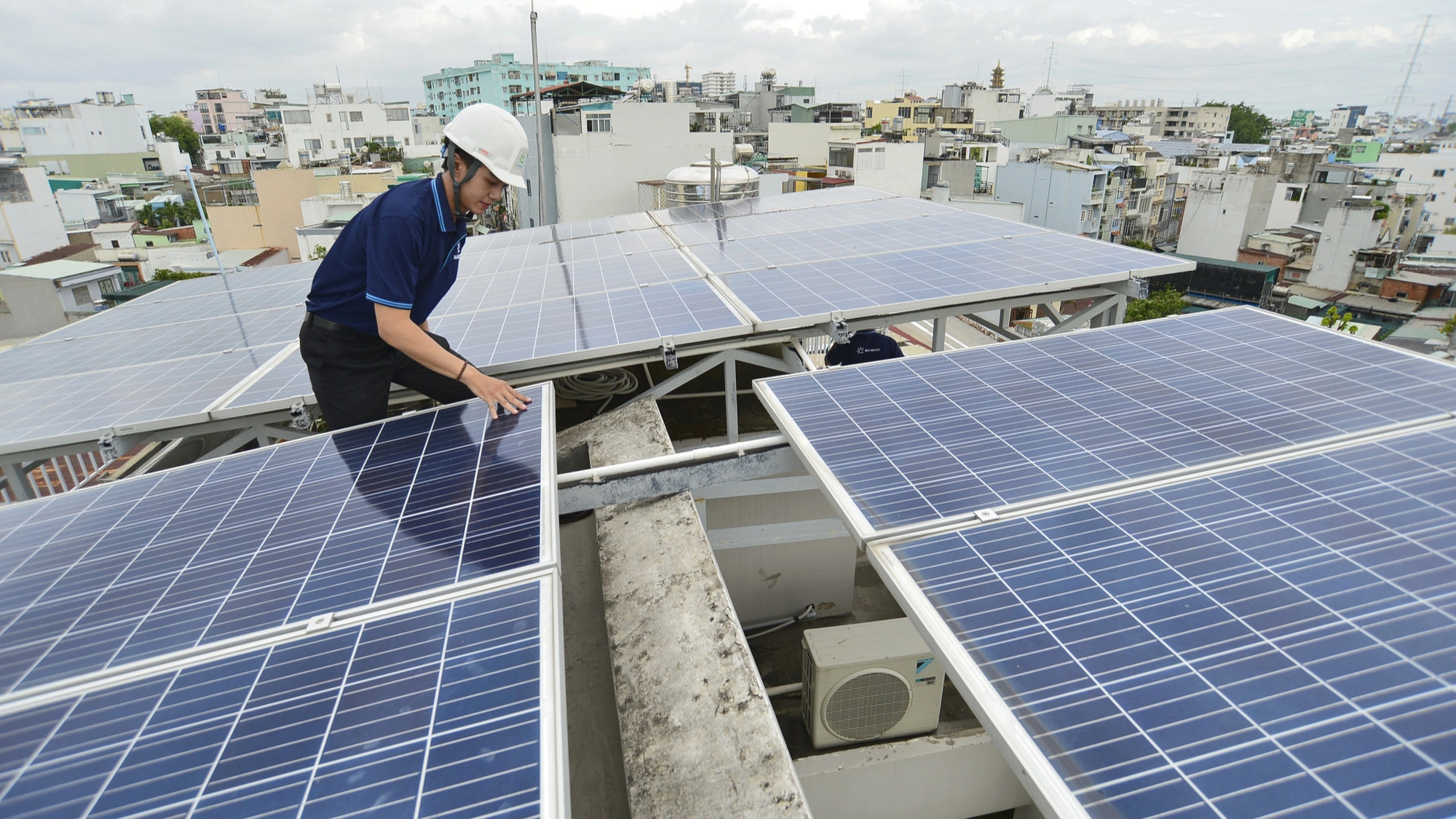
Rooftop solar panels on residential houses in Binh Thanh District, Ho Chi Minh City (photo taken on the morning of June 10) - Photo: QUANG DINH
Speaking at a meeting on August 13th to review and finalize the draft decree on self-sufficient rooftop solar power, Deputy Prime Minister Tran Hong Ha stated that there is still significant potential for the development of rooftop solar power in the North and that policies to encourage investment are needed.
Will rooftop solar power have more room for maneuver?
Therefore, the Deputy Prime Minister requested the Ministry of Industry and Trade to review the conditions to serve as a basis for adjusting the planning and opening up "room" for self-sufficient rooftop solar power, especially in the North (the current plan for grid connection with rooftop solar power is 2,600 MW - PV).
The Ministry of Industry and Trade is also required to study and standardize the percentage of surplus electricity from self-produced and self-consumed rooftop solar power sources sold to the national power grid at 20% of the actual installed capacity.
For metering and data acquisition systems, and supervisory control, if the installed capacity is less than 100 kWh, it will be connected to the power company's system. If the capacity exceeds 100 kWh, it must be connected to the power distribution dispatching system.
In particular, there must be technical management solutions to control power output and ensure system safety, especially for power sources connected to the medium-voltage grid.
The Deputy Prime Minister also instructed relevant units to calculate load demand, ensure system and transmission network safety, and submit a proposal to the Prime Minister for adjustment of the power plan.
For organizations and individuals that have developed self-sufficient rooftop solar power systems after December 31, 2020, transitional regulations will apply.
In this process, units and households that have installed but not connected to the electricity system must submit information to the competent authority that issued the development certificate to record the scale and location.
If additional surplus electricity generation is registered for the system, it must be done in accordance with the regulations of this decree.
Also at the meeting, Mr. Nguyen Anh Tuan, General Director of Vietnam Electricity Group, said that the entire northern region currently has about 700 MW of rooftop solar power, while the system's capacity can accommodate about 7,000 MW.
Mr. Do Van Nam, a member of the board of directors of the Northern Power Corporation, believes that with the draft regulations, people will be able to save electricity when using it during peak hours.
"By selling surplus electricity back into the grid, households can recoup their investment in about 5-6 years, while the lifespan of a solar panel is approximately 12-15 years," Mr. Nam said.
In addition, some opinions also discussed preferential policies for installing electricity storage systems and developing rooftop solar power in industrial zones and clusters to avoid overlapping with the direct electricity trading mechanism; and considering that the total capacity of self-generating and self-consuming grid-connected rooftop solar power should not exceed the capacity approved in the planning.



Unlimited power capacity with off-grid rooftop solar power.
According to the draft decree on self-sufficient rooftop solar power, organizations and individuals installing self-sufficient rooftop solar power systems not connected to the national power grid will be given priority for unlimited capacity development; grid-connected systems will also be exempt from electricity operation licenses.
However, if the capacity exceeds 1 MW and electricity is sold to the grid, a procedure for applying for an electricity operation license must be followed.
The procedures for registration and development, as well as the investment, construction, and acceptance processes, will also be streamlined according to the procedures issued by the Provincial People's Committee and guided by lower levels. The aim is to issue certificates in the simplest way possible, without creating new administrative procedures.
Source: https://tuoitre.vn/dien-mat-troi-mai-nha-duoc-ban-20-cong-suat-20240813234550887.htm