
In Vietnam, developing the cultural industry is also considered one of the important priorities, but there are still many challenges and obstacles.
The cultural industry plays a crucial role in preserving, promoting, and fostering cultural diversity, while also making significant contributions to the economic development of nations.
The importance of developing the cultural industry.
The cultural industry is understood as the process of applying scientific and technological achievements, along with business skills, and utilizing creative capacity and cultural capital to create cultural products and services that meet the consumption and cultural enjoyment needs of the people.
Currently, in the trend of integration, the cultural industry is increasingly asserting its important role in preserving, promoting, and fostering cultural diversity, and making a significant contribution to the economic development of each country.
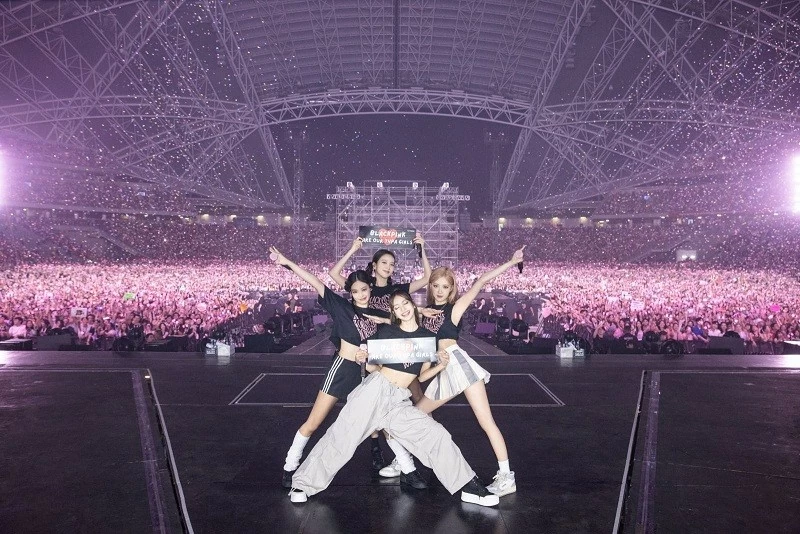 |
| The South Korean girl group Blackpink performed in Vietnam. (Source: Blackpink) |
According to the United Nations report on the creative economy, in 2023, the total share of cultural industries accounted for approximately 2.9% of global GDP.
Specifically, data from the UK National Statistics Office shows that creative industries, including cultural industries, account for approximately 5.9% of GDP; the German Federation of Creative Industries reports that cultural and creative industries in Germany account for approximately 5.5% of GDP.
According to a report by China's Ministry of Culture and Tourism, the country's cultural and creative industries account for approximately 4.5% of GDP, while data from South Korea's Ministry of Culture, Sports and Tourism also shows that the cultural industry accounts for approximately 4.5% of GDP.
In the United States, creative industries such as film, television, music, and performing arts account for approximately 4.3% of GDP (according to research by the U.S. Department of Commerce).
To achieve remarkable development in the cultural industry, countries such as the UK, Germany, South Korea, and China have made significant investments in high-tech infrastructure and a creative and professional workforce.
In particular, the governments in these countries have enacted appropriate legal policies along with proactive support programs such as providing financial resources, tax incentives, and other mechanisms.
In addition, these countries also focus their investments on a number of prominent cultural industry clusters, producing and distributing distinctive national cultural products, attracting investment resources and promoting the strong development of the cultural industry.
In Vietnam, the perspective on the development of the cultural industry was formed at the 6th National Congress of the Communist Party of Vietnam in December 1986 and continues to be mentioned in documents and resolutions of subsequent Party Congresses.
At the 13th National Congress of the Party, the issue of developing the cultural industry and promoting the soft power of Vietnamese culture was affirmed as one of the important contents for Vietnamese culture and people to truly become an endogenous strength, a driving force for national development and defense.
At the 2021 National Cultural Conference, the late General Secretary Nguyen Phu Trong also emphasized the requirement: “Building a digital cultural environment suitable for the digital economy, digital society, and digital citizens, making culture adaptable and regulating the sustainable development of the country in the context of the Fourth Industrial Revolution. Urgently developing cultural industries and building a healthy cultural market.”
Lessons for Vietnam
It can be seen that, after nearly 40 years of reform with cultural development policies, the cultural industry in Vietnam is gradually expanding and diversifying with main sectors such as: publishing, film, television, music, performing arts, tourism, advertising, games, software, design, handicrafts, etc.
UNESCO, the British Council, the Goethe Institute, and the Danish and Swedish embassies have also provided numerous consultations to help Vietnam enhance its understanding and awareness of the development of cultural industries in social life.
Vietnam is a country with a rich and diverse cultural heritage, ranging from historical sites and traditional arts to the unique cultural characteristics of its ethnic groups.
However, according to cultural researchers, the role and enormous potential of the cultural industry have not been properly appreciated, and therefore the policies supporting and incentivizing the industry are still inadequate and ineffective.
Associate Professor Dr. Nguyen Thi Thu Phuong, Director of the Vietnam National Institute of Culture and Arts, shared: "Vietnam has many resources but still lacks world-class cultural products due to a lack of commensurate investment."
We have learned from the experiences of all five top soft power nations that we need to select and transform cultural soft resources into cultural soft power. At this time, if we prioritize learning from a model, Vietnam should refer to the experience of South Korea."
According to Ms. Nguyen Thi Thu Phuong, before the emergence of the Korean cultural wave, the country had just gone through an economic crisis and chose to develop content industries (cultural industries), focusing on areas such as K-Pop, television dramas, and games, while maximizing their excellent technological infrastructure.
After K-pop became a South Korean brand, the country continued to capitalize on the Korean Wave's global reach, but with a greater focus on interactive digital products such as web tools, manhwa, and character comics.
Therefore, Vietnam needs to learn from the approach that the Koreans took in the initial stages to consider which cultural soft resources are necessary and focus on solving the problem of transforming them into cultural soft power.
It can be said that in our country, there are still quite a few obstacles to the development of the cultural industry, and the production and distribution capacity of businesses in this field is also limited.
Many small businesses lack capital, technology, and management experience, making product manufacturing and marketing difficult.
The distribution, marketing, and promotion systems for cultural products are also not yet well-developed; the domestic market for Vietnamese cultural industry products has not yet been fully exploited.
The demand and purchasing power of the people for these products are not yet high, while competition with foreign cultural products remains a significant challenge.
The core issue is that investment in cultural development, including the cultural industry, remains low. State budget allocations for this sector are insufficient, while attracting private investment into the industry faces numerous difficulties due to policy and regulatory barriers.
Despite its rich, diverse, and distinctive cultural identity, Vietnamese cultural industry products still lack originality, practicality, and expressiveness, failing to highlight cultural identity effectively.
Therefore, the products of this industry have not met the increasingly high demands for cultural enjoyment and consumption in both domestic and international markets. Consequently, the domestic cultural market is being encroached upon by cultural industry products from cultural powerhouses in the Asian region with Vietnam, such as South Korea, Japan, and China.
The process of globalization is happening very rapidly, making it easy for weaker cultures to fall into a situation where they cannot adapt quickly enough and protect their identity.
Currently, Vietnam lacks a clear legal framework for managing and controlling the business of cultural products. There is a shortage of legal documents clearly defining the role of state management, responsibilities, and powers of ministries, sectors, and localities in implementing state management of the cultural industry.


This leads to an increase in low-quality cultural products and copyright infringement. Furthermore, many businesses involved in the cultural industry, driven by economic gain, create works that are mediocre in form, or even contain harmful, toxic, and misleading content, affecting traditional values and distorting consumer perceptions, especially among young people.
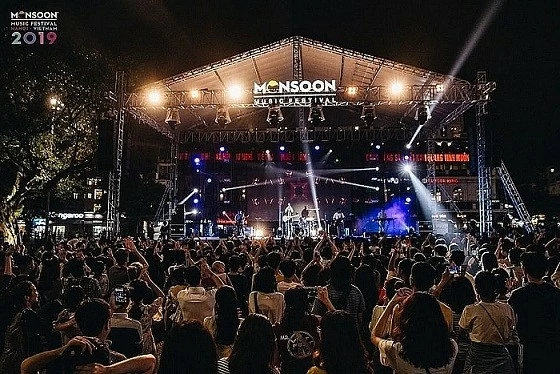 |
| Spectators attending the Monsoon International Music Festival in Hanoi. (Source: Organizing Committee) |
The German philosopher Theodor W. Adorno (1903-1969), who first used the term "cultural industry" in 1944, warned of the negative consequences of pursuing pure self-interest.
He argued that the cultural industry is a product of capitalism, and that scholarly cultural works would be transformed into popular culture; this would easily stifle human creativity, leaving only conformity and catering to vulgar entertainment tastes.
Undeniably, cultural industries are strategic assets in foreign policy and international cooperation, helping to strengthen national uniqueness and playing a key role in promoting cultural identity; they are also effective tools for economic growth and innovation.
The issue of cultural development and the cultural industry has also received special attention from our Party and State, but there are still many challenges and limitations that need to be addressed.
First and foremost, it is necessary to establish a suitable legal framework to promptly address shortcomings in the development of the cultural industry, ensuring consistency and harmony between cultural policies and other policies such as education, economy, and social affairs, thereby creating a healthy business and trade environment for the development of the cultural industry.
Most importantly, in the process of developing the cultural industry, special attention must be paid to avoiding conflicts between the goals of preserving and promoting traditional cultural values and promoting economic and commercial development.
Source: https://baoquocte.vn/cong-nghiep-van-hoa-dung-chay-theo-thi-hieu-tam-thuong-280991.html