
| In July, pepper exports to China dropped sharply. Agricultural products are currently the commodity that China has the highest demand for. |
On the morning of August 6th, the Department of Agriculture and Rural Development of Lao Cai province, in collaboration with SUTECH Science and Technology Consulting Co., Ltd., organized a workshop to guide businesses exporting plant-based food products to China.
Despite its potential, it faces difficulties when exporting to China.
In his opening remarks at the conference, Mr. Nguyen Quang Vinh, Deputy Director of the Department of Agriculture and Rural Development of Lao Cai province, stated that Lao Cai province has nearly 200km of border with 3 pairs of border gates, therefore, import and export activities in Lao Cai are extremely important. Notably, Lao Cai is also an important gateway connecting goods from many other localities to the Chinese market.
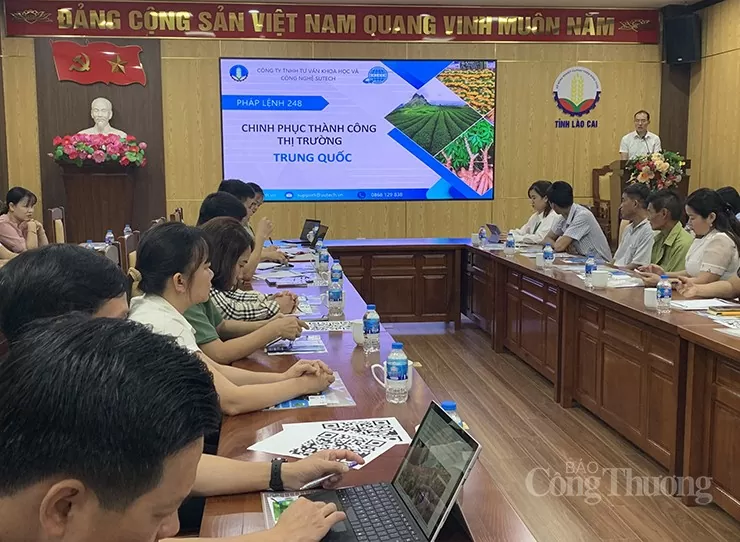 |
| Workshop to guide businesses exporting plant-based food to China. |
In the first half of 2024, Lao Cai province's import and export turnover reached 1.1 billion USD, of which export turnover reached nearly 600 million USD, with agricultural products and food items playing a dominant role.
“Up to this point, local products such as cinnamon and cinnamon products are basically exported. Of that, the Chinese market accounts for almost 100% of Lao Cai's cinnamon essential oil, in addition to products such as medicinal herbs, cardamom, amomum, tea, and bananas,” said Mr. Nguyen Quang Vinh.
Currently, the Chinese market is demanding improved quality, planting area codes, and safe food practices in cultivation and harvesting. This poses a challenge for businesses, cooperatives, and individual farmers exporting to this market. This is why Vietnamese agricultural products in general, and those from Lao Cai in particular, face difficulties in exporting to this market despite their potential.
Regarding information on state management of planting area codes and packaging facility codes, Ms. Cao Thi Hoa Binh - Head of the Department of Crop Production and Plant Protection of Lao Cai province - informed that, as of 2023, Lao Cai still has 13 planting area codes and 7 packaging facility codes that meet export standards.
Regarding some difficulties in issuing and managing planting area codes and packaging facility codes, Ms. Cao Thi Hoa Binh said that the requirements for standards of importing countries (China) for agricultural products are becoming increasingly stringent and frequently changing, causing certain difficulties for localities and export businesses in updating information as well as in implementation.
The issuance of new planting area codes has only recently come into operation, so awareness among some stakeholders remains limited; managing these codes is still challenging. Some localities, organizations, and individuals have focused only on expanding the area of planting zones and packaging facilities without paying sufficient attention to strictly complying with the requirements of importing countries.
Some key industries and products of the province currently have a significant export advantage but are not yet included in the Protocol and Orders 248 and 249 (such as pineapples, medicinal herbs...). The cinnamon industry, in particular, has a large production area but still lacks strict control over growing regions (there are no specific guidelines on assigning planting area codes to cinnamon trees). Therefore, although some localities have requested planting area codes for cinnamon trees, this cannot be implemented due to the lack of guidance.
The management of planting area codes for organizations, individuals, businesses, and cooperatives is currently limited to following guidelines; the process of gathering and providing information to businesses remains inadequate…
Businesses cannot export without understanding the market.
At the conference, Ms. Phan Thi Men – Director of SUTECH Science and Technology Consulting Company – presented an overview of China Customs Order 248, the difficulties faced by businesses when applying it in practice for exporting agricultural products to the Chinese market and to countries like the US and India; and provided guidance on specific regulations for some typical products of Lao Cai such as cassava chips, spices (cinnamon, star anise, etc.), tea, bananas, pineapples, medicinal herbs… to the Chinese market.
According to Ms. Phan Thi Men, after 30 months of implementing Order 248 of China Customs, Vietnam has now registered more than 3,000 export codes to the Chinese market, which have been categorized into product groups and submitted to the relevant ministries and agencies for management.
In Lao Cai province specifically, businesses have exported several agricultural products such as bananas, cassava, and cardamom. However, many of the province's potential agricultural products have not yet accessed the Chinese market, and the export of agricultural products to other markets worldwide remains limited due to various reasons such as changing policies in importing countries and Vietnamese businesses not having timely access to information from importing countries.
To illustrate this point, Ms. Phan Thi Men stated that last year they advised approximately 500 businesses exporting to the Chinese market. During the consultation process, one very large exporting company, with annual revenue of tens of trillions of VND, submitted an export application to China but failed to meet the requirements simply because it could not prove the source of the water it used. If a business deliberately disregards these requirements, it will be very difficult for it to participate in the export process.
"With the Chinese market , there have been many changes recently. If businesses don't keep up with the information and policies, they will fall behind," advised Ms. Phan Thi Men.
SUTECH, in its consulting services related to the 248-based management system, has also completed numerous guidance sessions for businesses in the industry to help them successfully export to the Chinese market. Besides consulting activities, the company has also received many requests and solutions from businesses.



"With the regular coordination of the consulting unit and relevant departments, in some provinces, especially those with favorable border conditions adjacent to China, there are shared concerns about the product registration process, changes in the Chinese market, and the necessary regulations and requirements to boost agricultural exports to China and other countries around the world," Ms. Men said.
Standardizing product quality to meet China's requirements is the most important solution for achieving high efficiency in official exports and opening up this market to more products in the future.
Therefore, from the local perspective, Mr. Nguyen Quang Vinh stated that they will continue to support and promote the development of concentrated raw material areas with certified quality meeting advanced standards (VietGAP, organic, HACCP, ISO 22000, etc.) to serve agricultural exports.
Strengthening production linkages with processing and consumption of agricultural products enhances their value for export; promoting the transfer and application of science and technology in production, preservation, and processing improves the quality and competitiveness of agricultural products.
Source: https://congthuong.vn/lao-cai-ban-cach-thao-go-kho-khan-thuc-day-xuat-khau-nong-san-sang-trung-quoc-337195.html