
Gourds are no longer the cheap, unsightly fruit found on market stalls and ridiculed as "poor as a gourd fiber." Many people have switched to selling the fibers, turning them into environmentally friendly handmade products, and even exporting them abroad to earn dollars.
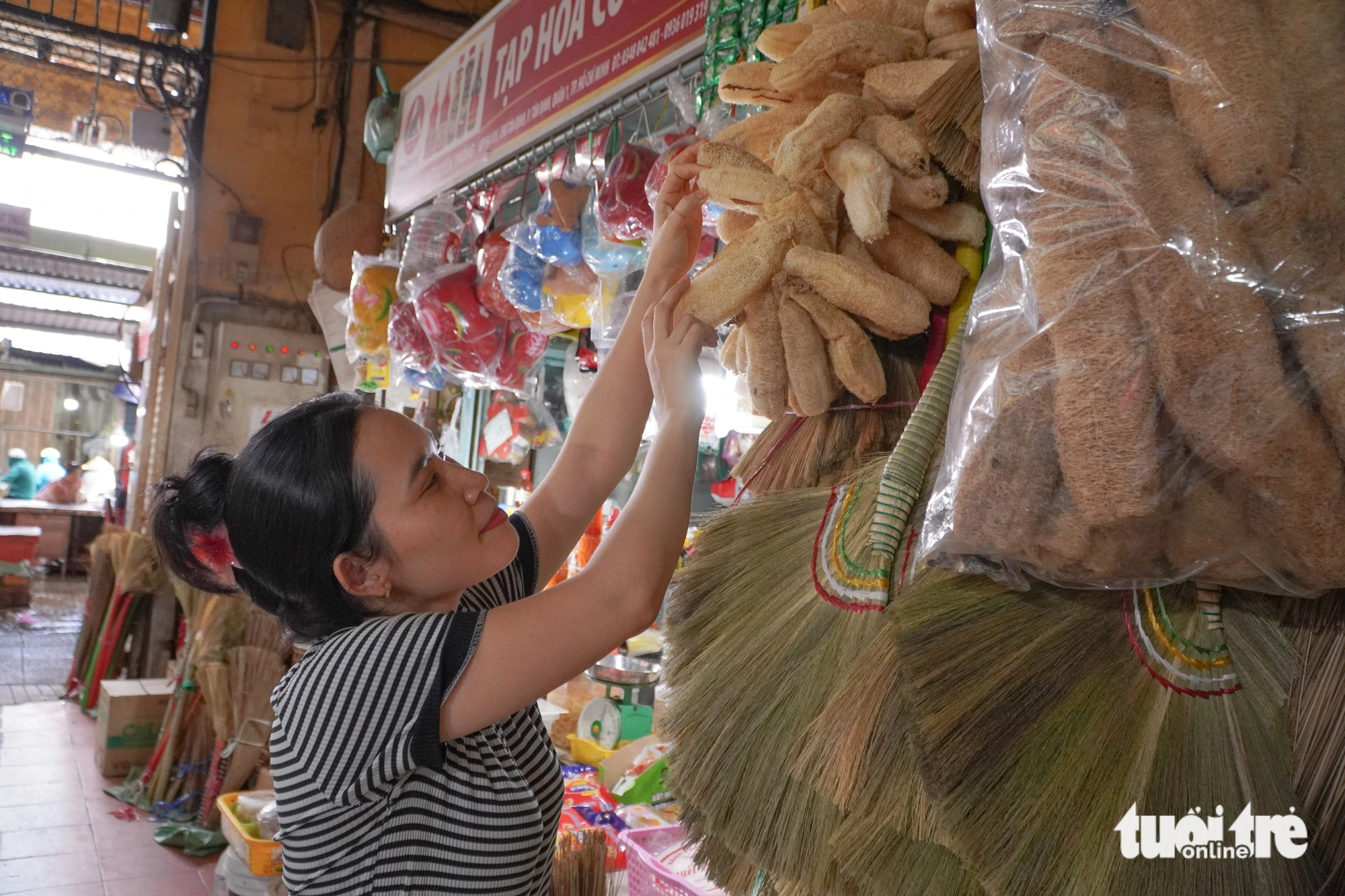
Handmade loofah products are displayed at the front of Ms. Hop's stall in Tan Dinh Market - Photo: AN VI
Visiting markets, it's not difficult to spot loofah sponges strung together by vendors and hung on their stalls. Or, when you type the keyword "loofah sponge" on e-commerce platforms, this product will appear in various whimsical shapes and at high prices.
The word "gift" is something no one will take.
Visiting Nghia Trung commune (Bu Dang district, Binh Phuoc province ), we found loofah sponges that have been an integral part of the S'tieng people's lives since time immemorial. They use loofah sponges as back scratchers, scouring pads, pot holders, and most notably, as a very gentle scrubbing tool during bathing.
Dried loofah gourds, if not peeled, can be stored for a long time, as long as they are kept away from moisture and fire. When using them, simply peel off the skin and seeds, soak them in water overnight to soften them, and they become a versatile product.
Loofah sponges have a very interesting texture; when dry, the skin sticks tightly and is difficult to peel. Inside, they contain many seeds, and the fibers are extremely rough. But after processing and soaking in water, they become surprisingly soft.
Ms. Dieu Thi Lai (43 years old, residing in Bu Dang district, Binh Phuoc province) said that compared to the dishwashing sponges or bath sponges made of plastic that she usually buys, loofah sponges last much longer. "After using them, I just wring them out, they dry and become stiff again, and I only need to replace them for half a year because they get discolored," Ms. Lai praised.
In Lai's house, loofah sponges hang loosely by the sink. Before using them, she dips them in a basin and squeezes them a few times to absorb water and soap. This natural item cleans well and provides a gentle bath, just as good as the colorful bath sponges in the supermarket.
Despite its versatility and durability, according to Ms. Lai, loofah sponges here are not considered a valuable product; people give them to each other to use, and sometimes they even throw away the excess. "Many households here usually scatter loofah seeds to harvest the fruit for cooking soup. If the fruit ripens, they wait for it to dry and store it for wiping pots or for bathing. Sometimes, there are so many fruits that they just let them wither and die on the vine," Ms. Lai recounted.
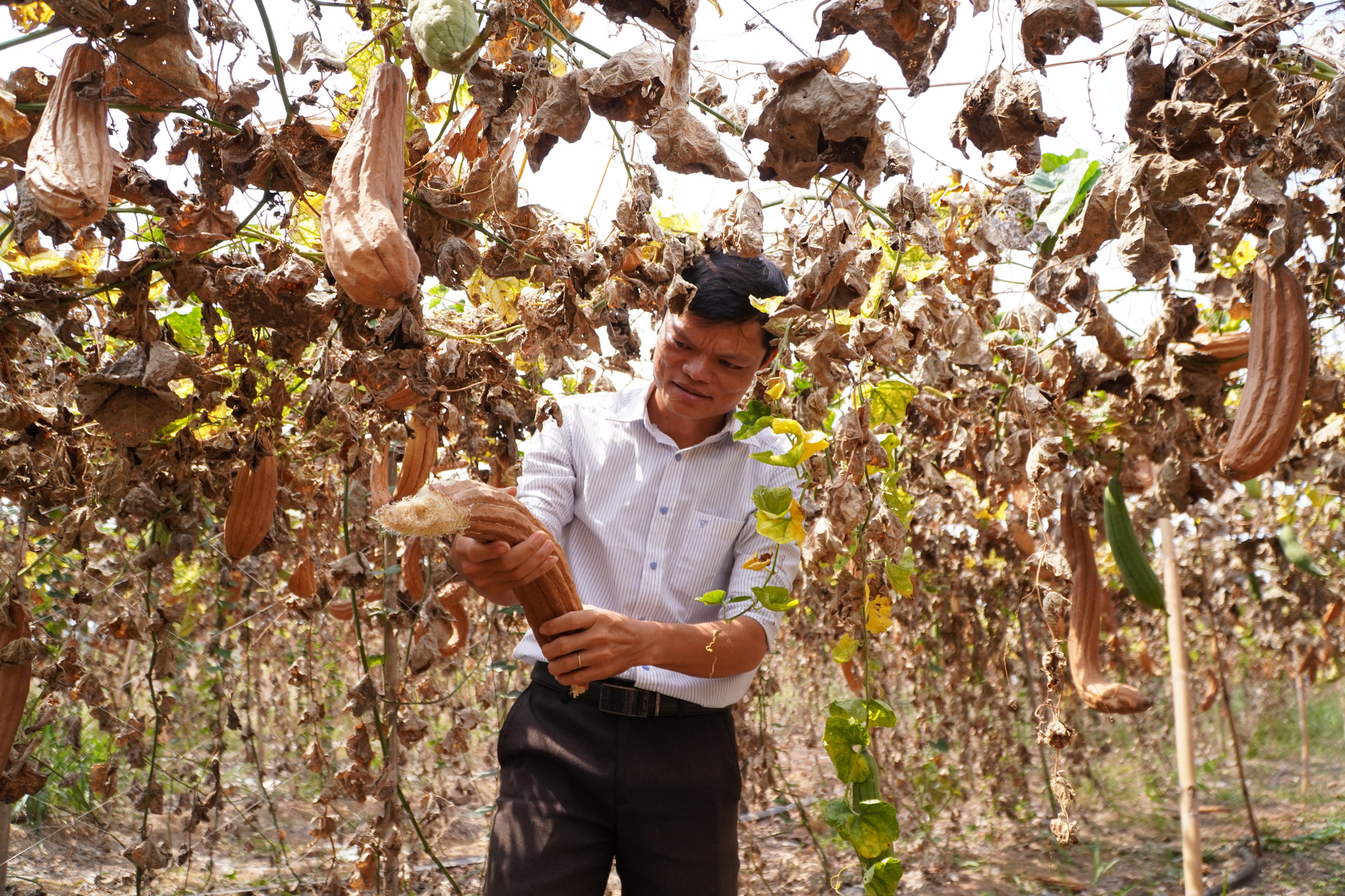
Tien's gourd farm exports about 500kg of dried gourds per season - Photo: AN VI
Loofah sponges are displayed on the handmade goods stall.
The situation for Ms. Truong Thi Anh Hong (50 years old, residing in Tan Binh District, Ho Chi Minh City) is that there's an oversupply of loofah sponges, and many people can't find them. Ms. Hong has been selling loofah sponges for nearly a decade in major markets in Ho Chi Minh City.
According to her, the amount of loofah sponges she initially sold was only a few dozen, but now it has reached hundreds. At times, she had to rent a truck just to transport enough to her customers.
Previously, she mainly collected loofah sponges from acquaintances in Long An province to sell, and after processing, the wholesale price ranged from 15,000 to 20,000 VND per piece. The product has become popular in the last 5 years, and the supply is insufficient to meet demand, so she started sourcing more loofah sponges from Long Khanh ( Dong Nai province), Can Duoc (Long An province), and many provinces in the Mekong Delta.
"Finding a place to buy loofah fibers is also very difficult. Most households only grow a few vines, and if they grow more, they usually sell the fresh fruit rather than the fibers because people are unfamiliar with the process. Not to mention, if the loofah fruit dries into fibers, it means that vine will no longer produce more fruit, so farmers are reluctant to sell this type," Ms. Hong explained.
Holding the loofahs, the woman meticulously pointed out that loofahs longer than 25cm, with thick fibers and a large, elongated shape, were considered the best. Loofahs under 25cm, with thinner fibers, were usually classified as grade 2 and sold at a lower price. As for those deformed during transport or discolored from being stored for too long, Mrs. Hong discarded them because buyers wouldn't accept them.
Following Ms. Hong as she delivered over 50 loofah sponges to a regular customer in Tan Dinh Market (District 1), as soon as she entered the market, she went straight to stall number 666, owned by Ms. Luu Thi Kim Hop (34 years old, residing in District 1, Ho Chi Minh City).
Seeing that Mrs. Hong only had a few dozen loofah sponges, the stall owner shook her head in dismay, "Why so few?" Mrs. Hong explained that the dry season had just ended, the supply of loofah sponges was scarce, and the buyers were also rushing, so that's all she had left. After a quick check, Ms. Hop threaded strings through the loofah sponges and hung them up at the front of the stall.
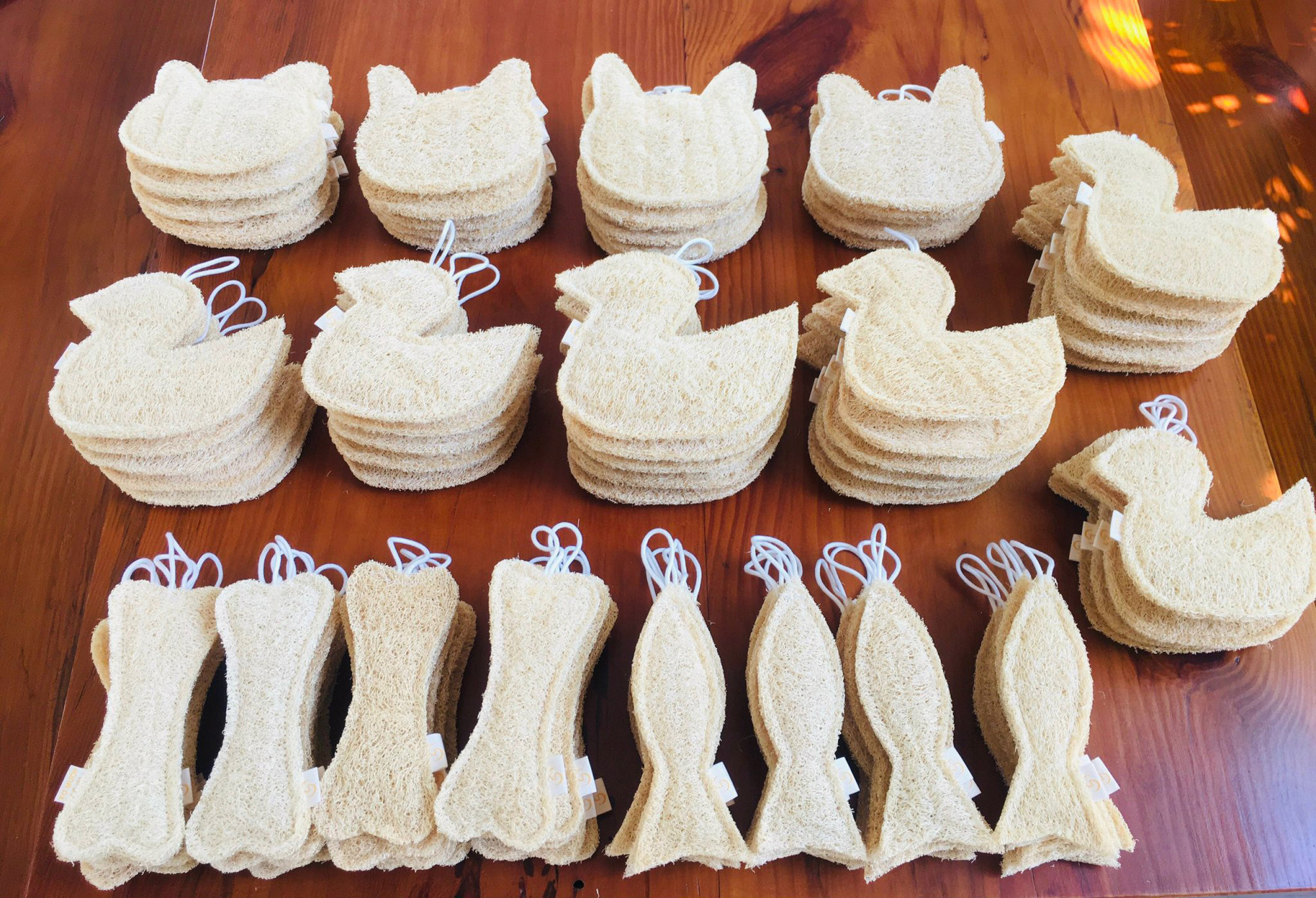
Loofah sponges are processed into various household items for export - Photo: AN VI
And we export to Japan, South Korea, etc.
More than half a month earlier, Ms. Hop had just sold out almost 50 loofah sponges. Of those, two groups of foreign tourists visiting the market bought more than half to try.
Without going into too much detail, while chatting with Ms. Hop, I noticed that out of a dozen Western men passing by, eight stopped to look around and touch the loofah sponges that the stall owner displayed. "Having her daughter here to help is great; she knows English, and if she explains things to them for a while, they'll definitely be curious enough to buy some to try," Ms. Hop chuckled.
The number of loofah gourds exported abroad is not just a couple of dozen; I went to the farm of Mr. Nguyen Van Tien (34 years old, residing in Chon Thanh town, Binh Phuoc province) - which supplies about 500kg of dried loofah gourds for export each season.
Looking at the lifeless, neglected loofah vines, one might guess that in Mr. Tien's garden, there are always three workers constantly weeding, fertilizing, and checking on the fruit. It's safe to say that growing and waiting for the loofah to dry like this is even more hard work than selling fresh fruit.



Currently, Mr. Tien's farm is collaborating with a partner in Gia Lai. His 3 hectares of loofah will provide raw materials year-round for processing and shaping into export products such as bath sponges, dishwashing sponges, shoe insoles, etc.
According to Tien, the market that is most fond of this product is South Korea. "There, people like to use handmade household products, especially those made from natural materials like loofah. Initially, they only bought a few because they found it unusual, but now they order several hundred kilograms at a time," Tien added.
Besides South Korea, Mr. Tien's loofah is also exported to Japan, the United States, and several European countries – markets with extremely strict regulations, especially regarding the residue of fertilizers and pesticides used in cultivation.
Regarding income, the man said that each harvest yields a profit of about 25-30 million VND/hectare. On average, if his purchasing partners buy regularly, he earns about 300 million VND per year from 3 hectares of gourds.
Nguyen Hoang Long, the owner of a loofah processing facility in Cu Chi district (Ho Chi Minh City), said that he has started having foreign partners for the past two years. His facility has created many products from loofah, most notably a line of bath sponges that are exported to Japan and South Korea. The products have also achieved OCOP 3-star and 4-star certifications.
Besides orders placed by partners, many Western customers find Long's products through his fan page and e-commerce platforms. He said that in the near future he will strengthen online promotion and seek more large partners so that loofah sponges can reach a wider market.
The loofah gourd is no longer ridiculed as a symbol of poverty, but is now opening up many opportunities for farmers to become wealthy...