
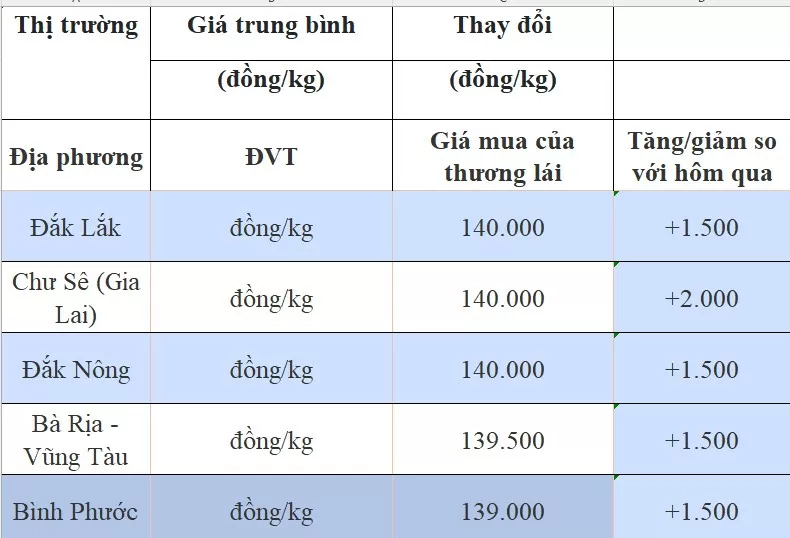
Today, August 15, 2024, pepper prices in the Southeast region increased by 1,500 - 2,000 VND/kg in some localities compared to yesterday, trading around 139,000 - 140,000 VND/kg, with the highest purchase price in Dak Lak and Dak Nong provinces at 140,000 VND/kg.
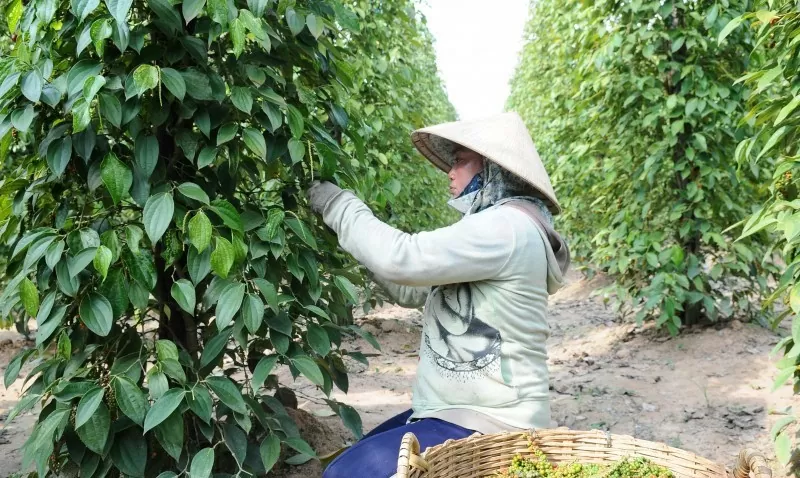 |
| Pepper prices today, August 15, 2024: Continuing the strong upward trend, a new price range has been established. |
Specifically, the price of pepper in Dak Lak is being purchased at 140,000 VND/kg, a slight increase of 1,500 VND compared to yesterday. The price of pepper in Chu Se (Gia Lai) is being purchased at 140,000 VND/kg, an increase of 2,000 VND compared to yesterday. The price of pepper in Dak Nong today is recorded at 140,000 VND/kg, an increase of 1,500 VND/kg compared to yesterday.
In the Southeast region, pepper prices today increased by 1,500 VND/kg compared to yesterday. Specifically, in Ba Ria - Vung Tau, the price is currently 139,500 VND/kg, up 1,500 VND/kg from yesterday; in Binh Phuoc, the price is 139,000 VND/kg, up 1,500 VND/kg from yesterday.
Thus, today's pepper prices (August 15th) increased slightly by 1,500 VND/kg in some key growing areas, reaching a high of 140,000 VND, fluctuating between 139,000 and 140,000 VND/kg.
Domestic pepper prices on August 15, 2024
 |
Vietnam's major agricultural products, including coffee, pepper, and rice, are facing risks in exporting to the European Union (EU), as well as experiencing a decline in exports to China. Faced with these challenges, the Vietnamese agricultural sector needs to find ways to adapt in order to maintain its position in the international market.
According to information from the Vietnam National Notification and Inquiry Point on Sanitary and Phytosanitary Measures (SPS Vietnam), the EU will begin implementing new regulations on maximum residue limits (MRLs) from February 2025.
The list of products affected by the new regulations includes many key agricultural products such as coffee, pepper, rice, along with durian, bananas, mangoes, and vegetables such as onions, garlic, and chili peppers. These products are not only major exports from Vietnam to the EU but have also contributed significantly to the country's total export turnover for many years.
Today's world pepper prices
According to the International Pepper Association (IPC), at the close of the most recent trading session, the IPC listed Indonesian Lampung black pepper at US$7,424/ton, up 1.21%, and Muntok white pepper at US$8,741/ton, also up 1.21%.
Brazilian ASTA 570 black pepper prices remained at US$6,175/ton. Malaysian ASTA black pepper prices remained stable at US$8,500/ton; Malaysian ASTA white pepper prices reached US$10,400/ton.
Vietnamese black pepper prices remain high, trading at US$5,800/ton for the 500 g/l variety; US$6,200/ton for the 550 g/l variety; and white pepper at US$8,500/ton...
This year's pepper market has been extremely volatile, unlike previous years. However, overall, pepper is about to enter an upward price cycle. This cycle may not last 5-7 years, but possibly 10 years.
This is due to market mechanisms and supply and demand. However, making accurate predictions about pepper prices in the coming period is very difficult.
According to the newly released 2024 report on the status of pepper cultivation by the Vietnam Pepper and Spice Association, Decision No. 431/QD-BNN-BNNPTNT of the Ministry of Agriculture and Rural Development dated January 26, 2024, approving the plan for the development of key industrial crops until 2030, stipulates that pepper cultivation is planned to cover an area of 80,000 - 100,000 hectares nationwide.
In terms of advantages, pepper is an agricultural crop with a long history of development, closely associated with the lives of many generations of people in the Central Highlands provinces, and has become a concentrated commodity production sector, meeting the requirements for export to the world market.
Provinces have issued policies to encourage the development of agriculture in general and high-tech agriculture in particular to support production development and increase value, including pepper cultivation.
Regarding difficulties, the application of technical procedures for planting, caring for, and harvesting, as well as the application of scientific and technological advancements, is still limited in areas inhabited by ethnic minorities.



The infrastructure is inadequate and outdated. Production is still too dependent on natural conditions. In addition, mechanisms, policies, and solutions for sustainable pepper development have not been effectively implemented in practice.
The extreme fluctuations in pepper prices lead to many risks. From now until the start of the new harvest season (around January), a shortage is certain, but whether the shortage will be severe or whether businesses can withstand it until the new season is something no one can assess. This is because pepper has the characteristic of being able to be stored year after year.
According to experts, pepper prices have risen again this year, but farmers are not under pressure to sell early like in previous years because coffee and durian prices have also increased, and many households have stable incomes.
*This information is for reference only. Prices may vary depending on the time and location.
Source: https://congthuong.vn/gia-tieu-hom-nay-1582024-tiep-da-tang-manh-vung-gia-moi-lai-duoc-thiet-lap-339059.html