Identity cards pave the way for special demographics.
Báo Thanh niên•19/11/2024
After having their information and biometric data collected by the police to issue identity cards, many people with special demographics at the Hiep Binh Chanh Social Welfare Center for the Disabled (Hiep Binh Chanh Ward, Thu Duc City, Ho Chi Minh City) burst into tears of happiness.
Recognizing that vulnerable populations require immediate attention and support, the Public Security Police force of Ho Chi Minh City has implemented the "Journey to find digital identities for vulnerable people" with the motto "leaving no one behind".
So happy that it was done quickly and efficiently.
On the morning of August 4th, the Police Department for Administrative Management of Social Order (PC06) of the Ho Chi Minh City Police, in coordination with the Police Department for Administrative Management of Social Order (C06) of the Ministry of Public Security and the Department of Labor, War Invalids and Social Affairs, organized the issuance of identity cards to 117 individuals with special needs who are being cared for and nurtured at the Hiep Binh Chanh Social Welfare Center for the Disabled (abbreviated as HBC Social Welfare Center) in Hiep Binh Chanh Ward, Thu Duc City. Most of these individuals are orphans or people with disabilities. For them, this center has become a second home, a place of care and support, compensating for their material and spiritual deprivations.
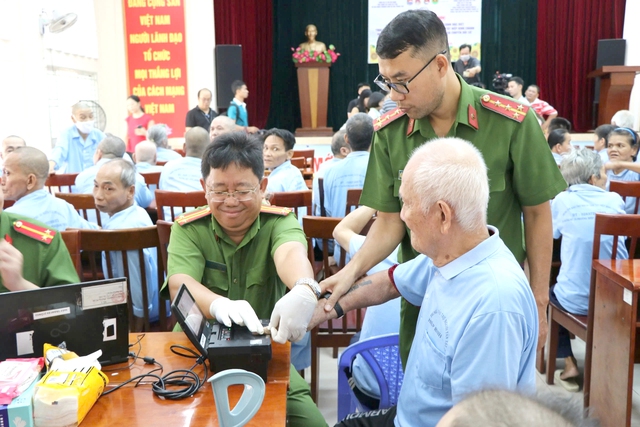
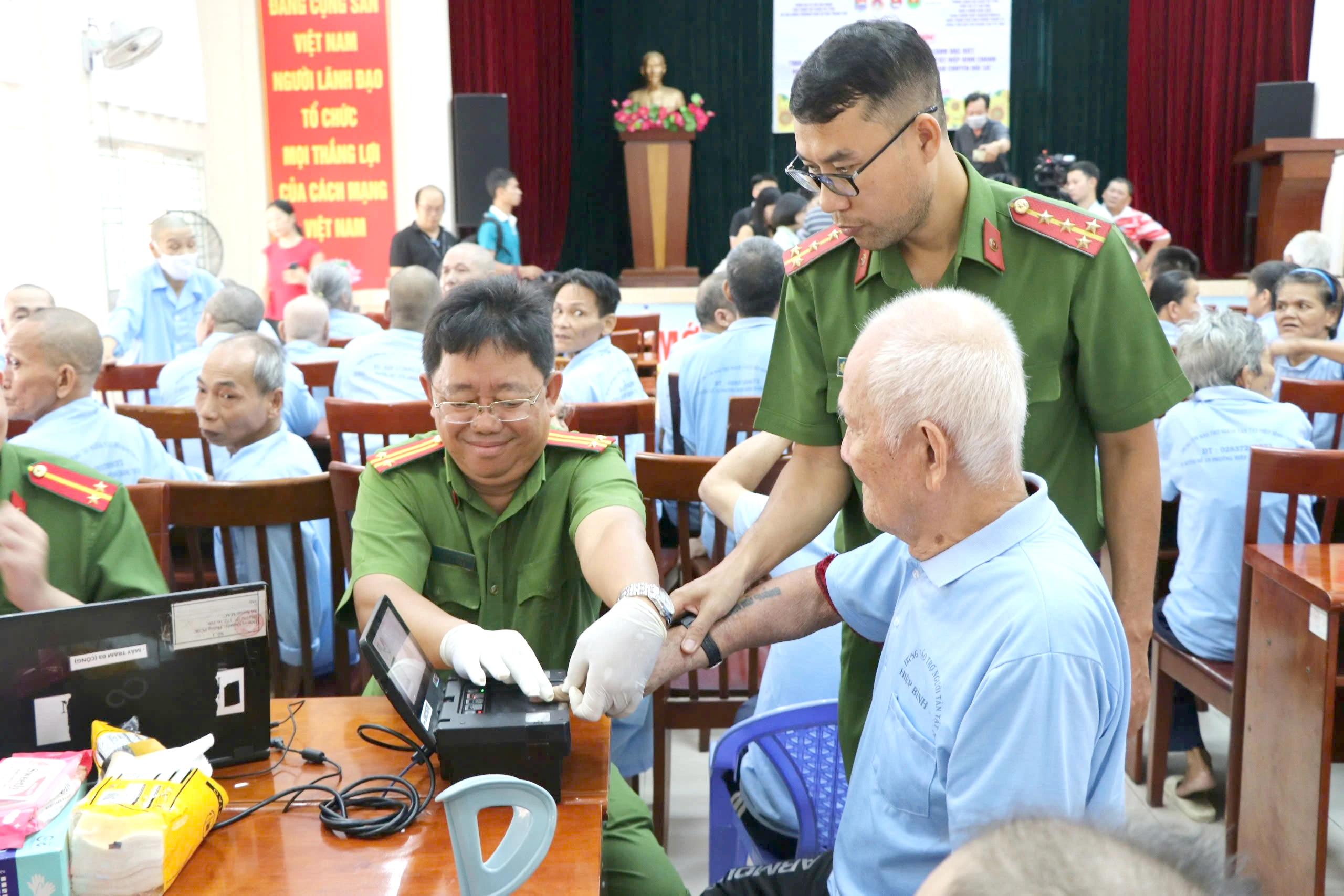
At each step of collecting biometric information from a specific demographic, two police officers provide support. (Thao Nhan)
From 7:30 AM, nearly 20 officers from PC06 of the Ho Chi Minh City Police, Thu Duc City Police, and Hiep Binh Chanh Ward Police checked the equipment, ready to collect information for the issuance of Certificates of Eligibility (TCC) for 117 special residents at the Social Welfare Center for the Elderly and Disadvantaged Children. At exactly 8:00 AM, the first people were assisted and guided to the TCC area. Each TCC information collection team consisted of 5-6 police officers assisting special residents with taking photos, collecting iris scans, and fingerprinting. When their names were called, each person proceeded to the fingerprinting and iris scanning area and was then guided to sit in position for a portrait photo. Police officers were always present to assist with adjustments and guidance if necessary. Because information about these individuals had already been verified by the Hiep Binh Chanh Police and integrated into the national population database according to the "accurate - complete - clean - living" standards, the collection of additional identification and biometric information was very quick and efficient, taking less than 5 minutes. According to Lieutenant Colonel Nguyen Thi Hong Chau, Team Leader of Team 2 (PC06), during the information collection process, it was inevitable that some individuals with special needs would become agitated or anxious. With the spirit of "serving the people" and "leaving no one behind," the police force always strived to create a cheerful and relaxed atmosphere, reassuring these individuals and ensuring the information collection process proceeded smoothly.
Burst into tears when receiving the TCC (Traditional Chinese Medicine) treatment.
Mr. Huynh Cong Vien (52 years old) is one of the special individuals at the Center for the Protection of Children with Disabilities - HBC who has been processed for the issuance of a Certificate of Conformity. Unlike others, Mr. Vien was born with a physical disability. He choked up as he said, "I was abandoned in a trash can; the nuns found me and took me in."
Mr. Huynh Cong Vien choked up as he shared his personal story. (Thao Nhan)
During the conversation with the Thanh Nien reporter, Mr. Vien choked up several times, apologizing for not being able to clearly explain his circumstances: "I lived with the nuns when I was little, but after they passed away, I had to seek refuge here." Given his difficult circumstances, he had no identification documents whatsoever. It wasn't until 2009, when he decided to seek refuge at the Hiep Binh Chanh Center for the Protection of Children with Disabilities, that Mr. Vien received assistance from the staff in obtaining a birth certificate and was assigned an identification number by the Hiep Binh Chanh Police to proceed with the application for a Certificate of Eligibility. Having met police officers for the first time in his life to apply for a Certificate of Eligibility, Mr. Vien expressed his happiness, repeatedly saying, "I'm overjoyed." Clasping our hands tightly, Mrs. Tran Thi Diep (69 years old, from Ben Tre) said tearfully, "I've been alone all my life, without any documents." Mrs. Diep recounted that she was born into a poor family in Ben Tre, and her parents died early. As a teenager, she followed her neighbors to Ho Chi Minh City hoping to escape poverty. However, life in the city was not as she dreamed. Ms. Diep's life was marked by "three no's": no relatives, no home, and no identification documents, forcing her to work various jobs to make a living. Fortunately, she met a kind person who adopted her as a sister and brought her to live with their family in District 4. However, due to her advanced age, frail health, and severe diabetes, and fearing she would become a burden to her sister, Ms. Diep applied to join the Center for the Protection of Children with Disabilities - HBC in 2013. Since joining the center, Ms. Diep has received support in obtaining a birth certificate, purchasing a health insurance card, and enjoying many special benefits. When she heard that police officers would be coming to the center to collect documents for the TCC (Traditional Vietnamese Medicine) program, Ms. Diep eagerly awaited it. Although she had to wait in line, prioritizing other vulnerable cases, Ms. Diep said she didn't feel tired or bothered. "Thanks to the police officers who helped us get our identification documents and TCCs, we are so happy to be Vietnamese citizens," Mrs. Diep sobbed.
"The journey to find digital identity for the disadvantaged"
Issuing Citizen Identification Cards (CICs) to individuals classified as "special population" is a crucial aspect of implementing Plan No. 1878/KH-BCĐ dated April 20, 2023, of the Steering Committee for Project 06 of Ho Chi Minh City. This plan focuses on coordinating the collection of population data, issuance of personal identification cards, settlement of residency issues, and issuance of Citizen Identification Cards (CCCD) and CICs for individuals classified as "special population" in the city. "Special population" refers to individuals in difficult circumstances, without family support, orphans, and people with disabilities, who are currently being cared for in social welfare centers. For various reasons, they lack personal identification documents, causing difficulties in management and administrative procedures.
According to Lieutenant Colonel Nguyen Thi Hong Chau, issuing Citizen Identification Cards (CICs) is extremely important for vulnerable groups, helping them confidently become true citizens. "In addition, issuing CICs facilitates the work of state agencies, especially in implementing social welfare policies more easily and conveniently for these vulnerable groups," Lieutenant Colonel Chau emphasized. The team leader of Team 2 (PC06) stated that in recent times, PC06 has actively coordinated with social welfare centers and the Department of Labor, War Invalids and Social Affairs to issue CICs to vulnerable individuals at facilities such as the Thu Duc City Mental Health Rehabilitation Center and other centers for the elderly and disabled in Ho Chi Minh City. "Specifically, we also deployed forces to drug rehabilitation centers throughout the city to issue Citizen Identification Cards (CCCD) and Citizen Identification Cards (TCC) to people undergoing rehabilitation," Lieutenant Colonel Chau said, adding that after one year of implementing the Government 's Project 06, the Ho Chi Minh City Police Department issued nearly 2,000 CCCDs and TCCs to vulnerable people in the city. Regarding the issuance of TCCs to city residents, according to Lieutenant Colonel Ho Thi Lanh, Deputy Head of PC06, the Ho Chi Minh City Police Department has implemented the "Journey to find digital identification for vulnerable people" with the motto "leaving no one behind," contributing to bringing the Government's Project 06 closer and more practical to the lives of the people.
Iran has again blockaded the Strait of Hormuz.On June 19, Iran reimposed a blockade on the Strait of Hormuz, citing Israel's refusal to withdraw its forces from southern Lebanon and the continued presence of US troops in the region.
Lieutenant Colonel Nguyen Ngoc Hai, Deputy Head of PC06, Ho Chi Minh City Police, said there are three cases where it is mandatory to apply for a new Citizen Identification Card (CIC): citizens aged 14 who have never been issued a CIC or Citizen Identification Card; citizens who already have a Citizen Identification Card but it has expired; and citizens who already have a Citizen Identification Card (CMND). The Deputy Head of PC06 stated that according to the 2023 Citizen Identification Law, the 9-digit CMND will no longer be valid by December 31, 2024. "Therefore, citizens currently using a 9-digit CMND should schedule time to apply for a CIC to ensure convenience in future procedures and transactions," Lieutenant Colonel Hai said. Citizen Identification Cards issued before July 1, 2024, remain valid until their expiration date. However, if a citizen's CMND has not yet expired but they still need a CIC, the authorities will still accept the application. Regarding the validity of the Citizen Identification Card (CCCD) and the Citizen Identification Card (CMND) while awaiting the issuance of the new card, the Deputy Head of PC06 stated that, in accordance with Clause 3, Article 25 of the 2023 Citizen Identification Law, citizens can still use their CCCD for transactions as usual while waiting to receive the new card. "When citizens come to the police station to receive the new card, we will proceed with the revocation of their CCCD and CMND as per regulations. However, Vietnamese citizens who have been issued a new card must go through the procedure to renew it when they reach the ages of 14, 25, 40, and 60," Lieutenant Colonel Hai said. According to Lieutenant Colonel Nguyen Ngoc Hai, if citizens of Ho Chi Minh City encounter difficulties or problems in the registration, management of residence, issuance, and management of CCCD, or have contacted the local police without success, they can report it via the hotline 0693187111.
Conditions for granting TCC to special population groups.
Lieutenant Colonel Hoang Tuan Hai, Head of Hiep Binh Chanh Ward Police, stated that individuals with special circumstances need a birth certificate and must have been assigned an identification number to be eligible to register for a Citizen Identification Card (TCC). To assist, Hiep Binh Chanh Ward Police regularly deploys task forces to the Social Security and Information Protection Center in Hiep Binh Chanh to collect fingerprints and gather information. After collecting fingerprints, Hiep Binh Chanh Ward Police will search the archives at the Ho Chi Minh City Police Department to find the background information of each individual. For cases with available information, Thu Duc City Police will clean up the data and issue TCCs in the first round. For cases without identification documents, the police will send the information to the judicial sector for verification. "Cases with birth certificates will have their data cleaned, be assigned an identification code, and then be issued a Certificate of Identification. Cases with absolutely no information will have a new birth certificate issued by the judicial department of the People's Committee of Hiep Binh Chanh Ward; they will use the surname of the center's director for identification purposes," Lieutenant Colonel Hai said.
Hanoi City police worked late into the night, until all tasks were completed, to receive applications for temporary residence permits.
According to statistics from C06 (Ministry of Public Security), as of August 1st, one month after the 2023 Citizen Identification Law officially came into effect, the police had issued chip-embedded citizen identification cards to over 2.195 million citizens nationwide, including more than 736,000 citizens aged 14 and above. The 2023 Citizen Identification Law stipulates that previously issued citizen identification cards remain valid until their expiration date; therefore, citizens do not need to switch to new cards unless they require replacement. For special cases such as the elderly, infirm, or disabled who cannot personally go to the location to apply for a new card, Article 6 of Circular 17/2024/TT-BCA clearly outlines support measures. Specifically, in cases of the elderly, the sick, the victims of accidents, the disabled, and other special circumstances, the agency responsible for issuing identity cards will come to the citizen's residence to collect documents and data if it has sufficient means, technical equipment, and personnel. In Hanoi, police units are still increasing their efforts, working late into the night to collect applications for identity cards. According to the head of PC06 (Hanoi City Police), the majority of the demand for identity cards currently comes from children, who are newly eligible for cards under the Identity Card Law, due to their travel needs. Regarding special cases such as the elderly and disabled, the head of PC06 stated that previously, there were mobile teams that went to people's homes to issue identity cards, but this is not currently being implemented because some data collection equipment, such as voice recording booths, does not meet the requirements for mobility. The head of PC06 of the Hanoi City Police said they are awaiting further guidance from the Ministry of Public Security and will deploy mobile citizen identification card issuance services for these citizens in the near future. For now, these individuals can use their old citizen identification cards until their expiration date. Source: https://thanhnien.vn/the-can-cuoc-mo-loi-cho-nhan-khau-dac-biet-185240804224718654.htm