
| Vietnam's textile and garment group prepares to produce its first order of flame-retardant fabric. Sustainable production: What challenges are textile and garment businesses facing? |
According to information from the Vietnam Textile and Garment Group, the Regulation on Eco-design for Sustainable Products, which replaces the current Eco-design Directive 2009/125/EC and establishes a framework for setting eco-design requirements for specific product groups, has come into effect.
The Eco-Design Regulation for Sustainable Products applies to “all goods” brought into the EU market or used in the EU, regardless of their origin, including goods brought in from outside the EU market. This regulation broadens the scope compared to the previous Eco-Design Directive, which was limited to energy-related products. Simply put, any product not governed by its own specific law falls within the Regulation's scope. However, there are some exceptions for food, medical products, and live plants.
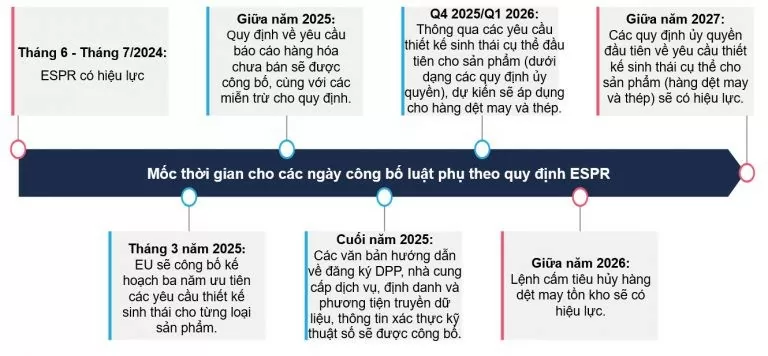 |
| Timeline for the publication dates of supplementary laws as stipulated in ESPR regulations. Photo: Vinatex |
The EU Commission will focus on establishing regulations for the following products: iron, steel, aluminum, textiles (especially clothing and footwear), furniture, tires, detergents, paints, lubricants, and chemicals. For textiles, the EU Commission has begun work on preparing specific requirements and will publish a list of priority products every three years in a separate work plan.
The regulations on ecodesign for sustainable products prohibit the destruction of unsold clothing, accessories, and footwear. This ban will take effect two years after the regulations officially come into force (i.e., mid-2026).
Textile businesses will be required to report unsold goods on their websites and are encouraged to report this in their annual sustainability reports. Firstly, the Regulations impose an obligation to disclose information and provide transparency on the business's website. Accordingly, each fiscal year, businesses must disclose the following information: the quantity and weight of products destroyed each year, the reasons for destruction, the waste disposal methods used, and measures taken to avoid destruction.
The obligation to disclose information about destruction applies to large enterprises in the first full fiscal year after the regulations come into effect, i.e., 2026/2027. For medium-sized enterprises, the disclosure obligation is in 2030/2031 (6 years after the regulations come into effect). However, small and micro enterprises (SMEs) are exempt from certain obligations to avoid an unnecessary burden on these small businesses.
A key aspect of the Regulation is the introduction of Digital Product Passports, which serve as comprehensive digital records of essential product information and must be available on websites and on garments. The EU Commission will establish a dedicated website portal where all digital product passports will be registered. The data stored on products linked to the Digital Product Passports is still being decided by the EU Commission and is expected to be known for textiles by the end of 2025.



Products without a Digital Product Passport will not be permitted to circulate in the EU market. Imports into the EU will have to provide a Digital Product Passport for customs verification during customs clearance to be allowed free circulation in the EU. The EU Commission will publish the technical standards for Digital Product Passports to guide companies and passport providers before December 31, 2025.
According to the Vietnam Textile and Garment Group, detailed regulations on eco-design requirements may not take effect until a year from now, and are therefore expected to be implemented in the second half of 2025. In addition, the EU is expected to announce a three-year work plan prioritizing eco-design requirements for each product category in March 2025, providing more detailed guidance on when products will be subject to stricter monitoring.
Source: https://congthuong.vn/quy-dinh-cam-tieu-huy-hang-det-may-ton-kho-cua-eu-khi-nao-co-hieu-luc-336610-336610.html