
Green production, optimization
Engineer Nguyen Duc Hiep - Head of the Technical Department of Xuan Mai Construction Investment Joint Stock Company shared that, in the context of the general difficulties in the housing construction market, the company has taken a unique approach by continuously winning bids for industrial housing projects with FDI capital such as Nitori, SMC, Asahi, SLP, Logos, and Toho projects. To achieve this, the company constantly improves technology in the construction field, applies energy-saving solutions, and focuses on developing environmentally friendly products and services.
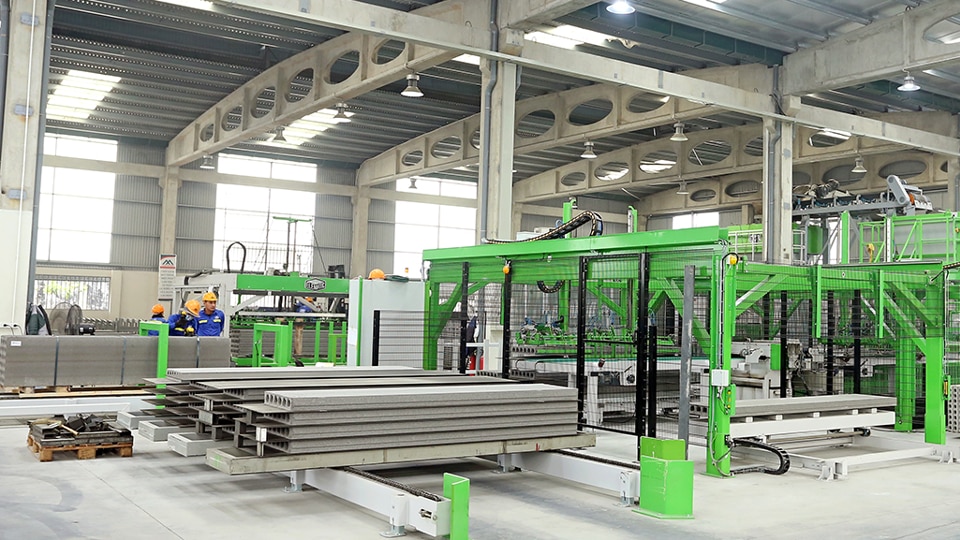
According to Mr. Nguyen Duc Hiep, the company has invested in a factory system producing Acotec wall panels, which have been widely used in many large projects, meeting criteria for product quality, fast construction progress, cost optimization, environmental friendliness, and are perfectly suited to modern construction trends to replace traditional brick walls due to their light weight, fast construction progress, and reduced labor requirements.
Acotec wall panels, manufactured by the company, are only 1/2 to 1/3 the weight of traditional brick walls, saving on foundation costs; they offer good sound insulation, heat insulation, and fire resistance; construction is 3-5 times faster than conventional brick walls, requiring less manpower and resulting in cleaner construction; electrical and plumbing installations can be done through the pre-existing voids in the panels, reducing labor costs for cutting and drilling walls by 50%…
"Acotec wall panels are being chosen by investors as the optimal solution to replace traditional fired bricks and other building materials in residential buildings, apartments, schools, hospitals, and high-end hotels (Pullman - Hai Phong , Citadines - Ha Long…), luxury apartments (Vinhome Ocean Park, Vinhome Smart City, Ecogreen Saigon…), and international schools," said Mr. Nguyen Duc Hiep.
Chairman of the Board of Directors of Trung Hau Machinery Manufacturing and New Materials Production Joint Stock Company, Tran Trung Nghia, shared that they prioritize using waste materials to produce construction materials in order to reduce costs. For the "cement-aggregate brick" product, the main raw materials are readily available in almost all localities, including additives, cement, sand or crushed stone; construction solid waste, and other industrial waste.
"The production cost is cheaper than traditional fired clay bricks because the cement content is very low and silica-based waste materials such as crushed stone and thermal power plant clinker can be used... Therefore, profits are higher due to the lower cost and we benefit from a reduction in corporate income tax for up to 10 years and access to preferential loans as stipulated by the Government ," said Mr. Tran Trung Nghia.
The reality is that natural resources, including natural building materials, are gradually being depleted due to overexploitation coupled with ever-increasing human demand. Furthermore, some building materials not only have negative impacts on human health but also pose a threat to the environment.
However, modernizing production and construction can help businesses better optimize the use of on-site materials and accurately monitor material usage to minimize waste.
Open solutions
Industry experts believe that future trends in architecture and construction will inevitably involve leveraging technological applications such as the Internet of Things (IoT) and intelligent automated control systems in building projects. Previously, architectural design took an average of 15 hours; now, with the support of AI-powered software like Chat GPT, Midjourney, and Architectures, this timeframe can be significantly shortened to produce a complete design.
For businesses in materials manufacturing, automating production lines and smartening equipment will improve efficiency and quality, while also controlling and improving equipment utilization. Standardized production management requires systematizing production schedules and establishing management mechanisms, thereby accurately allocating and calculating production costs, increasing pricing efficiency, and ensuring profitability.
Furthermore, understanding emissions, energy consumption, and implementing energy management according to ISO standards (14064, 14067, 50001) is essential to reduce emissions and save energy in the production process, ensuring sustainable development.
According to construction materials expert and Master Pham Ngoc Trung, construction material manufacturers, in an effort to optimize operations, improve safety, and reduce costs, will turn to AI applications. This is to gain a competitive advantage and is predicted to play a crucial role in construction material production in the near future.



Mr. Vu Thanh Hai, former Head of AI Application Department at Viettel Group, shared that AI has existed for a long time in traditional machine learning models (AI generation 1.0) such as facial recognition and anomaly detection. However, only in the last few years has AI truly exploded thanks to the emergence of generative AI (AI generation 2.0) with the ability to create new content such as text, images, and videos, and is applied to many specialized activities such as programming and problem-solving.
Despite its immense potential to help businesses achieve exceptional growth, applying AI to transform business operations remains challenging. This is because businesses must simultaneously undertake two tasks: effectively implementing AI Generation 1.0 and seizing new opportunities arising from AI generation (AI Generation 2.0).
"If you demand that AI applications deliver results and increase revenue within three months, that's very difficult. However, artificial intelligence will certainly create other potentials, such as enhancing customer experience, thereby providing more data for businesses," observed Master Vũ Thanh Hải.
Source: https://kinhtedothi.vn/huong-toi-hien-dai-hoa-nganh-xay-dung-vat-lieu.html