
Violent clashes in Bangladesh on August 4th, which left nearly 100 dead, risked continuing as students protested on August 5th, calling for a march to the capital Dhaka despite a curfew.
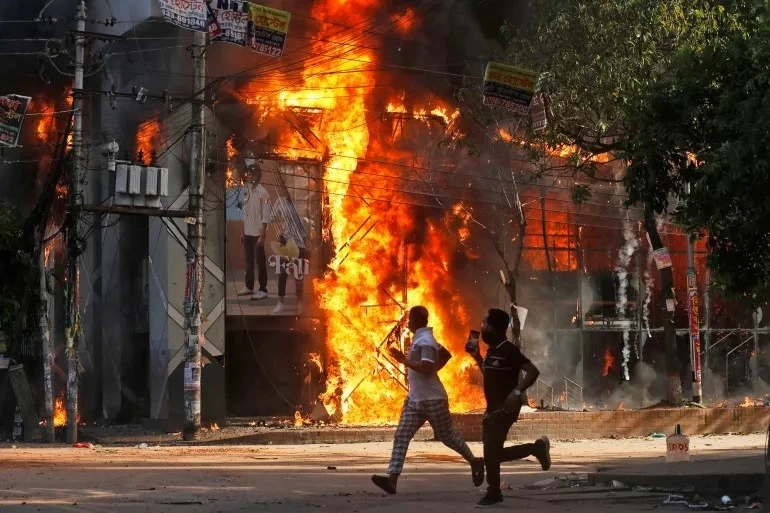 |
| A clothing store catches fire in Dhaka, Bangladesh, on August 4. (Source: AP) |
Reuters, citing an online news channel, reported that on August 5th, army tanks and police vehicles were present on the streets of the capital Dhaka, while security forces conducted infantry patrols. There was virtually no civilian traffic, except for a few motorcycles and tricycles.
Earlier, on August 4th, Al Jazeera reported that at least 91 people had been killed and hundreds injured in a wave of violence across the South Asian country of 170 million people, as police fired tear gas and rubber bullets to disperse tens of thousands of protesters.
Protesters blocked major highways and even vandalized a university medical hospital in the capital Dhaka. Bangladesh Health Minister Samanta Lal Sen condemned the actions and called for restraint.
Police used tear gas to disperse unruly crowds of protesters, while the Bangladesh Home Ministry imposed an indefinite nationwide curfew, starting at 6 p.m. local time on August 4 (7 p.m. same day in Vietnam).
Speaking after a national security council meeting on August 4, Prime Minister Sheikh Hasina condemned the protesters for destabilizing the country.
Violent protests erupted in Bangladesh in July, led by student groups, in opposition to state employment quotas.
The protests subsided when the Bangladesh Supreme Court overturned most quotas, allowing high-achieving students to apply for 93% of state jobs without being restricted by quotas. However, sporadic student protests resumed last week.


The unrest forced the Bangladeshi government to temporarily suspend high-speed internet services, while social media platforms like Facebook and WhatsApp were unavailable.
In light of this situation, on the same day, August 4th, UN High Commissioner for Human Rights Volker Turk expressed concern about the violence in Bangladesh and called for dialogue between the government and the protesters.
Source: https://baoquocte.vn/bangladesh-dung-do-bao-luc-khien-gan-100-nguoi-tu-vong-chinh-phu-tung-lenh-gioi-nghiem-vo-thoi-han-sinh-vien-bieu-tinh-tiep-tuc-thach-thuc-281412.html