
Beware of online scams offering "money recovery assistance."
Last week, a woman from Thanh Hoa, after being scammed while working as a sales agent for a brand, followed instructions from a service provider on social media, provided personal information, transferred "service fees," and was defrauded again.
Regarding the "get your money back" scam that is rampant on social media, people need to pay special attention and learn the signs to recognize and prevent it in time. Specifically, the perpetrators create fake accounts with no clear information about the company, address, or contact details.
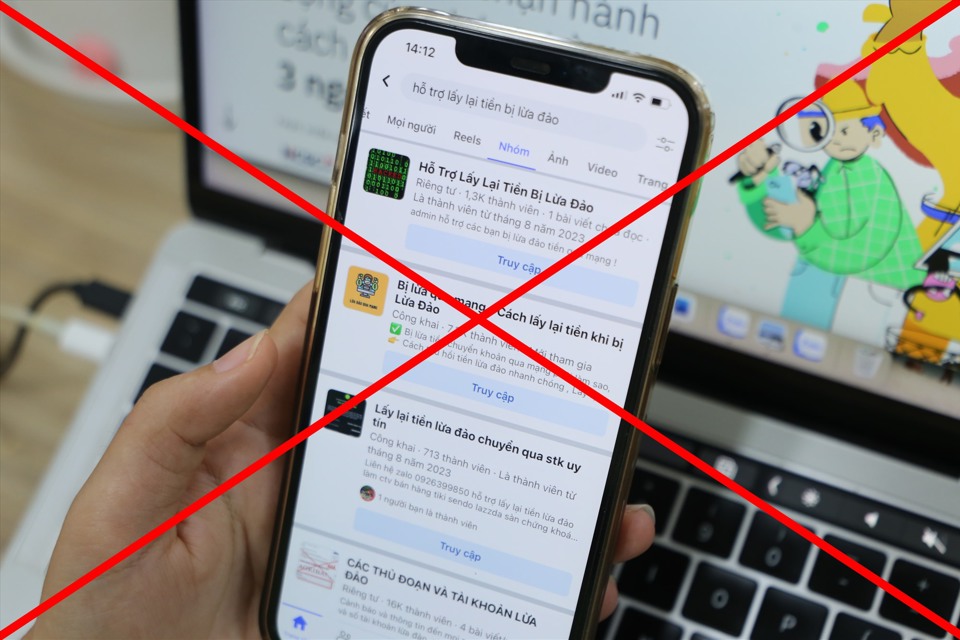
In light of this situation, the Information Security Department ( Ministry of Information and Communications ) advises people to absolutely not trust any "assistance in recovering money lost in scams" on social media. It is necessary to research the company or individual providing the service; verify their office address, phone number, and official website.
Do not trust services that require upfront payment of fees. Do not provide sensitive personal information in any form. If you suspect or have been a victim of such a scam, report it immediately to the authorities or investigative agencies for assistance and legal action.
Beware of scams selling prescription drugs on social media.
Recently, a victim of this scam reported buying traditional Chinese medicine for bone and joint problems from someone posing as a specialist doctor from a military hospital. Trusting the scammer, the victim ordered and used the medicine, but experienced unusual symptoms after use.
In this type of scam, the common tactic used by fraudsters is to operate in groups, creating fake social media accounts and posting advertisements for "miracle" drugs at high prices. Many of these pages lack contact information, only providing a phone number for consultation.

Besides those who call themselves "consultants," there are others whose job is to impersonate doctors at central hospitals to diagnose and prescribe medication.
These drugs range in price from a few hundred thousand to tens of millions of dong, with various purported uses such as: cancer prevention drugs, drugs to reduce the side effects of chemotherapy and radiation therapy, drugs for terminally ill cancer patients, but in reality, they are cheap drugs with ingredients of unknown origin.
More subtly, these groups also employ the tactic of offering "discounts" to the elderly, the poor, and the seriously ill, targeting the preference for promotions among certain consumer segments.
Following this information, the Cybersecurity Department (Ministry of Information and Communications) advises people to absolutely refrain from buying or selling on social media, especially for prescription drugs of unknown origin.
When people are sick, they should go to the hospital for direct examination and purchase medication under the advice and prescription of a doctor. They should be extremely wary of drug advertisements promising quick cures for serious illnesses or miraculous results without clear evidence.
Learn about the manufacturer and the medication through reliable sources such as the website of the drug regulatory agency or healthcare organizations.
In case of encountering such scams, people should report the fraudulent activities or counterfeit drugs to the authorities or consumer protection organizations. At the same time, they should share information about suspicious products with the community to warn others and help them avoid being scammed.
Fraudulent schemes related to overseas employment and visa-free tourism.
Taking advantage of people's desire to work abroad or travel to South Korea, the suspect created social media accounts and posted information seeking people interested in working in South Korea or traveling to Jeju Island (South Korea) without a visa. Using sophisticated methods, the suspect defrauded 10 people of over 747 million VND.
In this type of scam, the perpetrators typically create fake social media accounts and join groups to find users who need to buy airline tickets and apply for visas to travel abroad. They entice victims with promises of very short visa processing times or a high success rate without carefully checking the application documents.
Taking advantage of some people's lack of understanding of the visa application process, these individuals will request unnecessary information or demand advance payments for unclear fees.
After the victim transfers the money, the perpetrator will not contact any agency, organization, or individual to process the transaction, but will instead commit the act of misappropriation.
Furthermore, to avoid detection of the fraud, the perpetrator accessed the website Abay.vn, entered the victim's personal information to register for a flight to South Korea, took a screenshot, and sent it to the victim to build trust. Because Cuong did not pay for the ticket, the flight was automatically canceled within 24 hours.
The Information Security Department (Ministry of Information and Communications) advises people to verify the authenticity and information of the entities and service companies they contact. Visa applications should only be processed through certified agencies or visa services with a specific office address and clear contact information.
Absolutely do not access any suspicious links. Actively search for and access the websites of consular offices, embassies, or official organizations to learn about the visa application process. Do not trust services that promise quick visa processing or high success rates without thoroughly checking your documents.
In case of encountering individuals or entities exhibiting signs of fraud, people should report the suspicious services or websites to the authorities or consumer protection organizations to help prevent fraudulent activities.
Exploiting trademark protection tools to threaten and extort money.
Recently, the technology company Meta issued a warning about fraudulent activities using its trademark protection tool on the social media platform Facebook.
Specifically, a large number of Facebook users reported that the content they created and posted was taken down for copyright infringement. They then received messages from large companies and corporations, demanding access to links or payment of certain fees to restore the content, otherwise it would be permanently deleted.
Scammers actively search for videos with similar content or create their own videos using artificial intelligence to falsely claim user copyright. They then contact victims via email or social media platforms, requesting them to access links to provide personal information to verify ownership or pay fees to have the copyrighted content restored and continue using it.
Typically, these messages will come from unofficial or fake email addresses, containing extraneous characters or unusual writing style. In addition, the links attached to the messages often lead to strange websites with poorly designed interfaces, faulty fonts, and numerous advertisements.
In light of ongoing scams, the Information Security Department (Ministry of Information and Communications) advises users, especially content creators on social media platforms, to be vigilant against blackmail messages. If content is removed due to copyright infringement, users should contact the support team of their platform to resolve the issue. Carefully check email addresses.



Absolutely do not click on any suspicious links, provide personal information, or transfer money to anyone.
Amazon warns users to be wary of fake branded messages.
Amazon users have reported recently receiving numerous email messages regarding issues related to their purchasing process, requesting them to access links and provide information to resolve the problems.
Messages sent with content such as: “Payment method failed, for more details please access this link…” or “Amazon Prime account has expired…”, tend to request users to access attached links. After accessing these links, users will be asked to provide personal data, financial information such as credit card numbers, expiration dates, etc., or pay fees.
This is an extremely serious form of information theft, where the stolen personal data can be sold on dark web marketplaces or used to gain access to Amazon accounts and conduct illegal transactions.
Typically, these messages are sent from fake email addresses. These addresses often contain strange characters or do not end with @amazon.com. In addition, the content of the emails may contain spelling errors or unusual writing style (possibly written using translation tools or artificial intelligence).
In light of the ongoing scams, the Information Security Department (Ministry of Information and Communications) advises users of Amazon in particular, and other e-commerce platforms in general, to be highly vigilant against suspicious messages. Absolutely do not access any links, provide personal data, or bank information.
If you encounter any problems during the purchasing and shipping process, users should contact the support team directly through the app or the official phone number.
Source: https://kinhtedothi.vn/canh-giac-voi-ho-tro-lay-lai-tien-bi-lua-dao-tren-mang.html