
The hurried journey on a military plane marked the end of Sheikh Hasina's 15-year tenure as Prime Minister of Bangladesh, a South Asian nation of 170 million people.
Hasina, 76, resigned on August 5th under pressure from weeks of protests, which culminated in thousands of demonstrators defying a military curfew and storming her official residence in Dhaka.
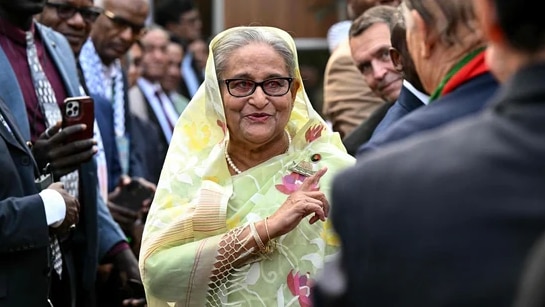
Sheikh Hasina resigned as Prime Minister of Bangladesh under pressure from weeks of protests. (Photo: Hindustan Times)
On the same day, Bangladesh Army Chief of Staff Waker-Uz-Zaman confirmed in a televised address that Hasina had left the country and that an interim government would be formed.
An unprecedented situation.
Once one of the world's fastest-growing economies, Bangladesh has recently been plagued by slowing economic growth, inflation, and unemployment.
Over the past few days, calls for Hasina's resignation have grown louder as hundreds of thousands of people have taken to the streets of Dhaka.
Student-led protests last month, fueled by frustration over a lack of decent jobs, quickly escalated into a nationwide movement and turned violent, leaving hundreds dead and thousands injured.
Despite curfews, internet outages, and tear gas from the police, protesters declared they would not stop until they achieved their goals. On August 5th, the Bangladeshi military reportedly gave Hasina only 45 minutes to resign.
Ms. Hasina appears to have accepted the offer and left Dhaka on a military helicopter. Media in neighboring India reported that Ms. Hasina's plane landed at an air base near New Delhi.
A senior source said she wanted to transit through London, but this could be difficult amid calls from the British government for a UN-led investigation into "unprecedented levels of violence".
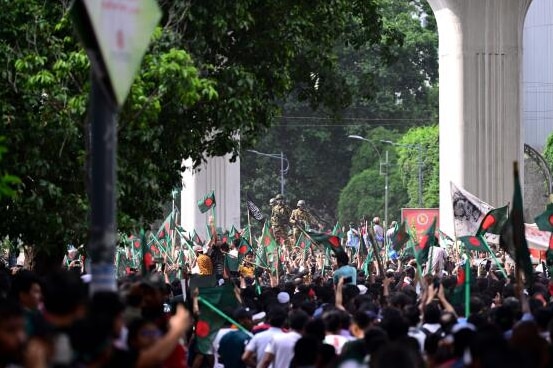
The wave of student protests quickly transformed into a movement demanding Sheikh Hasina's resignation as Prime Minister of Bangladesh. Photo: Le Monde
Speaking on state television on August 5, Bangladesh's army chief, General Waker-Uz-Zaman, said the protests should end and declared that "all injustices will be resolved."
Bangladesh President Mohammed Shahabuddin subsequently ordered the release of the detained protesters, as well as the release of former Prime Minister and key opposition leader Khaleda Zia, 78.
Later in the day, the President and Commander-in-Chief met with leaders of the major political parties – with the exception of Hasina's long-ruling Awami League party. The Bangladeshi President's press secretary said they had "decided to form an interim government immediately."
On August 6th, the Bangladeshi army lifted the curfew, and businesses and schools reopened.
Michael Kugelman, director of the South Asia Institute at the Wilson Center in Washington, D.C., said Hasina's departure "will leave a huge void" and that Bangladesh is in an "unprecedented situation." He said, "The coming days are crucial."
"The Iron Lady" of Bangladesh
Dubbed the "Iron Lady," Sheikh Hasina became Prime Minister of Bangladesh for the first time after her Awami League party won the 1996 elections and served until 2001.
Hasina returned to power for the second time in 2009. She was re-elected for consecutive terms afterward, and began her fifth term as Prime Minister of Bangladesh after the January elections this year amidst low voter turnout and a boycott of the general election.
Hasina, daughter of founding father Sheikh Mujibur Rahma, became the longest-serving leader in Bangladesh's history, surpassing other "Iron Ladies" around the world such as Margaret Thatcher (UK) and Indira Gandhi (India) in the number of election wins, and is the longest-serving female Prime Minister in the world.
Initially, Hasina's leadership was marked by the South Asian nation's impressive economic growth, largely driven by a predominantly female factory workforce that fueled the country's garment export industry.
Bangladesh, one of the world's poorest countries when it gained independence in 1971, has grown at an average rate of over 6% per year since 2009. Poverty has plummeted, and more than 95% of its 170 million people now have access to electricity, with per capita income surpassing that of India by 2021.


The garment industry generates over $55 billion annually, making Bangladesh the world's second-largest exporter of clothing, after China.
However, economic headwinds have left many dissatisfied with the government led by Hasina, following soaring food costs and months of chronic power outages in 2022.
In June, the government cut Bangladesh's annual GDP growth target and pledged to curb spending as the country grapples with an economy plagued by soaring inflation, an unstable exchange rate, and rapidly dwindling foreign exchange reserves.
Hasina herself has been accused of being a hardline leader, and the government she led has been accused of numerous violations of rights and abuse of state institutions to consolidate its power.
Minh Duc (According to ABC Net News, France24)
Source: https://www.nguoiduatin.vn/bangladesh-trong-tinh-huong-chua-tung-co-khi-thu-tuong-voi-roi-dat-nuoc-204240806164430465.htm