
The resignation of Sheikh Hasina, daughter of Bangladesh's founding father, who hastily fled to India after 15 years as Prime Minister, has plunged the South Asian nation of 174 million people into even deeper instability.
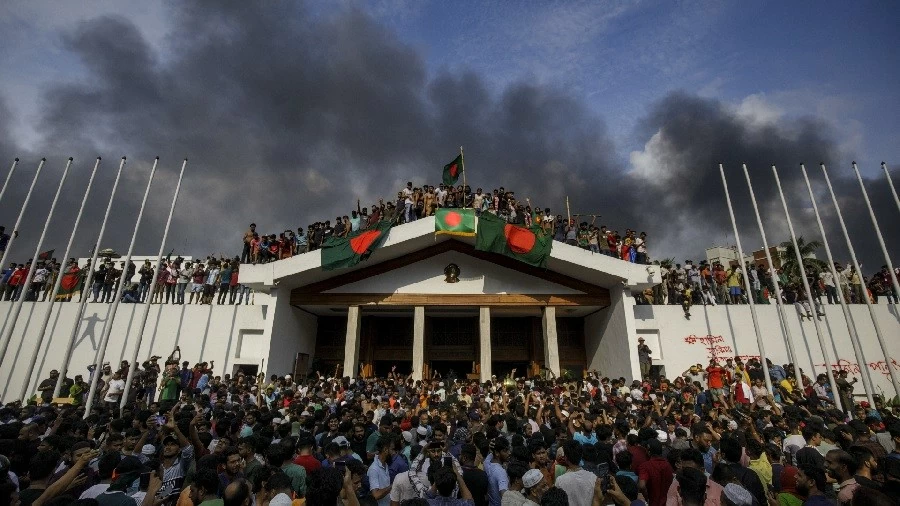 |
Violent protests in Bangladesh. (Source: Tageschou) |
Protests began erupting in Bangladesh in July after the country's Supreme Court reinstated a quota of up to 30% of government jobs reserved for relatives of veterans who fought in the 1971 war for independence from Pakistan.
This "privileged" quota system was established by then-Prime Minister Sheikh Mujibur Rahman, father of Sheikh Hasina, as a policy to commemorate the contributions of those who dedicated themselves to the cause of national liberation.
However, after more than 50 years, the descendants of veterans who fought for freedom account for only about 0.12% to 0.2% of the 174 million population, while there are as many as 18 million unemployed young people. Therefore, Prime Minister Hasina's government's policy of maintaining quotas was the "last straw," causing long-simmering resentment in society, especially among young people, to erupt into widespread violence.
The crisis, dubbed the "civil servant quota," bears many similarities to the "Arab Spring" revolutions 14 years ago in a number of Muslim Arab countries in the Middle East and North Africa. Protesters condemn the government's excessive use of force against peaceful opponents.
According to Reuters , at least 300 people have been killed in protests since the beginning of July. Meanwhile, Prime Minister Hasina's government denies the accusations and claims that "those who commit violence are not students but terrorists seeking to destabilize the country," further fueling student outrage.
Amid escalating violence, the Bangladeshi government imposed a nationwide curfew from 6 PM on August 4th. On August 5th, the country's army chief, General Waker-Us-Zaman, announced on television that an interim government would be formed. That evening, President Mohammed Shahabuddin agreed to the formation of an interim government and met with the heads of the Army, Navy, and Air Force, leaders of political parties, and members of civil society groups in Bangladesh to discuss solutions to stabilize the situation.
On August 6th, at the request of the protesters, President Mohammed Shahabuddin announced the dissolution of Parliament. The President decided to release former Prime Minister Khaleda Zia, chairman of the Bangladesh Nationalist Party (BNP), along with all those arrested during previous protests. On August 7th, 84-year-old Dr. Muhammad Yunus, a 2006 Nobel Peace Prize laureate for helping millions in rural Bangladesh escape poverty through small loans under $100, was appointed by various factions to head Bangladesh's interim government to temporarily de-escalate the situation.


Amid the current turmoil, the Bangladeshi army plays a crucial role in maintaining national order, tracking down and prosecuting those responsible for the deaths of protesters, and assisting the newly formed interim government in organizing new elections. However, this force will not play a leading role in governing the new government, as Commander-in-Chief Waker-Us-Zaman has stated in recent days.
Given the current situation, Bangladesh's future looks bleak, and political instability is likely to persist. The choice of the people between secular nationalism and Islamic nationalism in the upcoming elections will determine Bangladesh's political future. Regardless of the outcome, it is predictable that instability and economic hardship will continue to plague this South Asian nation in the foreseeable future.
Source: https://baoquocte.vn/bangladesh-giot-nuoc-tran-ly-281928.html