On August 2nd, in Hanoi, the Ministry
of Foreign Affairs, in coordination with relevant ministries, agencies, and localities, organized a conference to summarize 25 years since the signing of the border treaty and 15 years since the signing of three legal documents on the land border between Vietnam and China.
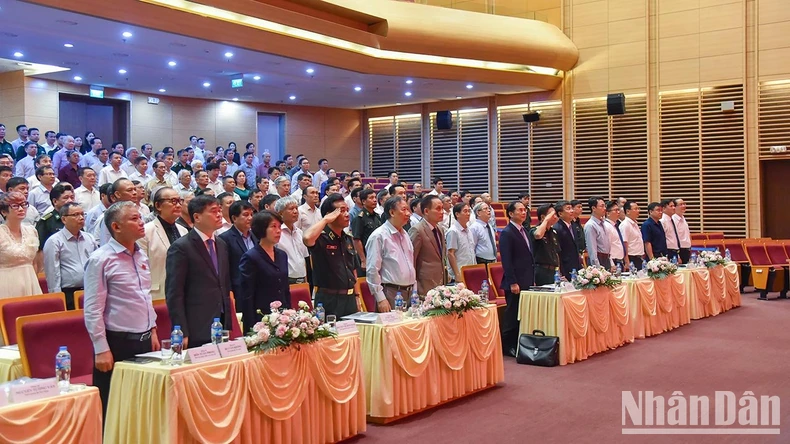
Delegates attending the conference participate in the flag-raising ceremony. (Photo: TRUNG HƯNG)
The conference was attended by Comrade Pham Gia Khiem, former Member of the Political Bureau, former Deputy Prime Minister and Minister of Foreign Affairs; Comrade Le Hoai Trung, Secretary of the Central Committee of the Party, Head of the Central Committee's Foreign Affairs Department; Comrade Bui Thanh Son, Member of the Central Committee of the Party, Minister of Foreign Affairs; Lieutenant General Nguyen Doan Anh, Member of the Central Committee of the Party, Deputy Chief of the General Staff of the Vietnam People's Army; Lieutenant General Le Duc Thai, Member of the Central Committee of the Party, Commander of the Border Guard; Comrade Nguyen Minh Vu, Alternate Member of the Central Committee of the Party, Permanent Deputy Minister of Foreign Affairs, Chairman of the National Border Committee, along with leaders, former leaders, officers and soldiers directly involved in border demarcation and border management and protection from relevant ministries, sectors and localities, with approximately over 300 delegates in attendance.
In his opening remarks at the Conference, Minister Bui Thanh Son affirmed that the signing of the Border Treaty, the completion of border demarcation and monument placement, and the signing of three legal documents on the border have immense historical significance, opening a new chapter in the relations between the two countries, marking an important turning point in the history of building the Vietnam-China border, and contributing to creating and maintaining a peaceful and stable environment in the region and the world. In addition, the completion of land border demarcation and monument placement also contributes to promoting
socio-economic development, especially between the border provinces of the two countries.
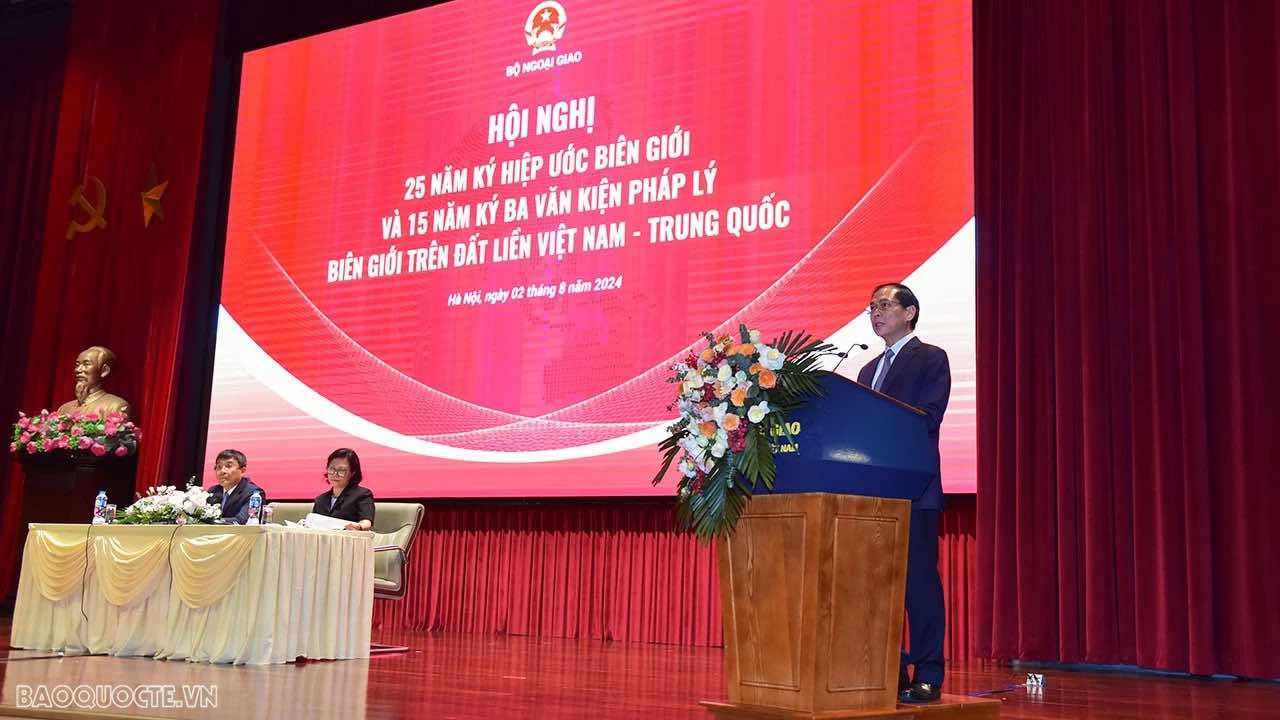
Foreign Minister Bui Thanh Son speaks at the conference. Photo: International News
The successful resolution of the land border issue between Vietnam and China is a significant milestone in the relationship between the two countries, which has experienced many ups and downs. It is an achievement built on the political determination, intellect, blood, and tears of countless generations of Vietnamese and Chinese people, especially in the new era under the leadership of the two Communist Parties. This historical achievement has laid the legal and political foundation for the two countries to maintain a peaceful and stable environment for economic development, ensuring security and defense... meeting the aspirations of the people of both countries. Since the three legal documents on the Vietnam-China land border came into effect and the two countries officially managed the land border according to these documents, the overall situation on the Vietnam-China land border has been basically stable, the border line and markers have been maintained; and social order and safety in the border area have been ensured. The opening and upgrading of border gates and the connection of transportation infrastructure are being actively implemented by both sides; friendly exchanges and cooperation in the border region are being promoted. The Vietnam-China Joint Border Committee and the relevant forces of both sides closely coordinate in border management and protection, promptly detecting and resolving any border incidents. The land border between Vietnam and China has been formed through historical processes and has existed relatively stably since the 10th century. During the colonial period, the French Government and the Qing Dynasty of China signed the Conventions of June 26, 1887, and the supplementary Convention of June 20, 1895 – these were the first international legal documents defining the border between Vietnam and China. Immediately after gaining independence, both sides paid attention to resolving border issues and conducted several negotiations, but without success. Following the normalization of relations in 1991, the two countries resumed negotiations on the territorial border. As a result, the Vietnam-China Land Border Treaty was signed by the Government of the Socialist Republic of Vietnam and the Government of the People's Republic of China on December 30, 1999. Between 2001 and 2008, both sides implemented border demarcation and monument placement on the ground. This resulted in the demarcation of the entire 1,449.566 km border, with 1,971 border markers erected, including one marker at the Vietnam-China-Laos tri-border junction, 1,548 main markers, and 442 auxiliary markers. This system of border markers has been marked, recorded, and described in accordance with the actual terrain, ensuring objectivity,
scientific accuracy, clarity, stability, and long-term sustainability. On November 18, 2009, the governments of the two countries signed three legal documents on the Vietnam-China land border to acknowledge the achievements of border demarcation and monument placement on the ground, establishing legal regulations for effective and smooth coordination in border management and protection, and the management and development of border gates between the two countries. The conference commemorating the 25th anniversary of the signing of the Border Treaty and the 15th anniversary of the signing of the three legal documents on the Vietnam-China land border is an opportunity to express gratitude to the generations of leaders and officials who participated in the planning, demarcation, and management of the Vietnam-China border from various ministries, sectors, and localities; it is also an opportunity for delegates to meet and exchange ideas, reminiscing about past work, sharing valuable lessons, and memorable experiences. Ministries, departments, and localities will exchange, summarize, and evaluate the achievements, results, and shortcomings arising in border management and protection to draw lessons learned, find solutions to overcome difficulties and obstacles, and contribute to maintaining a peaceful, friendly, stable, cooperative, and sustainable border for the people of both countries.
Vietnam.vn

 Việt Nam•20/11/2024