
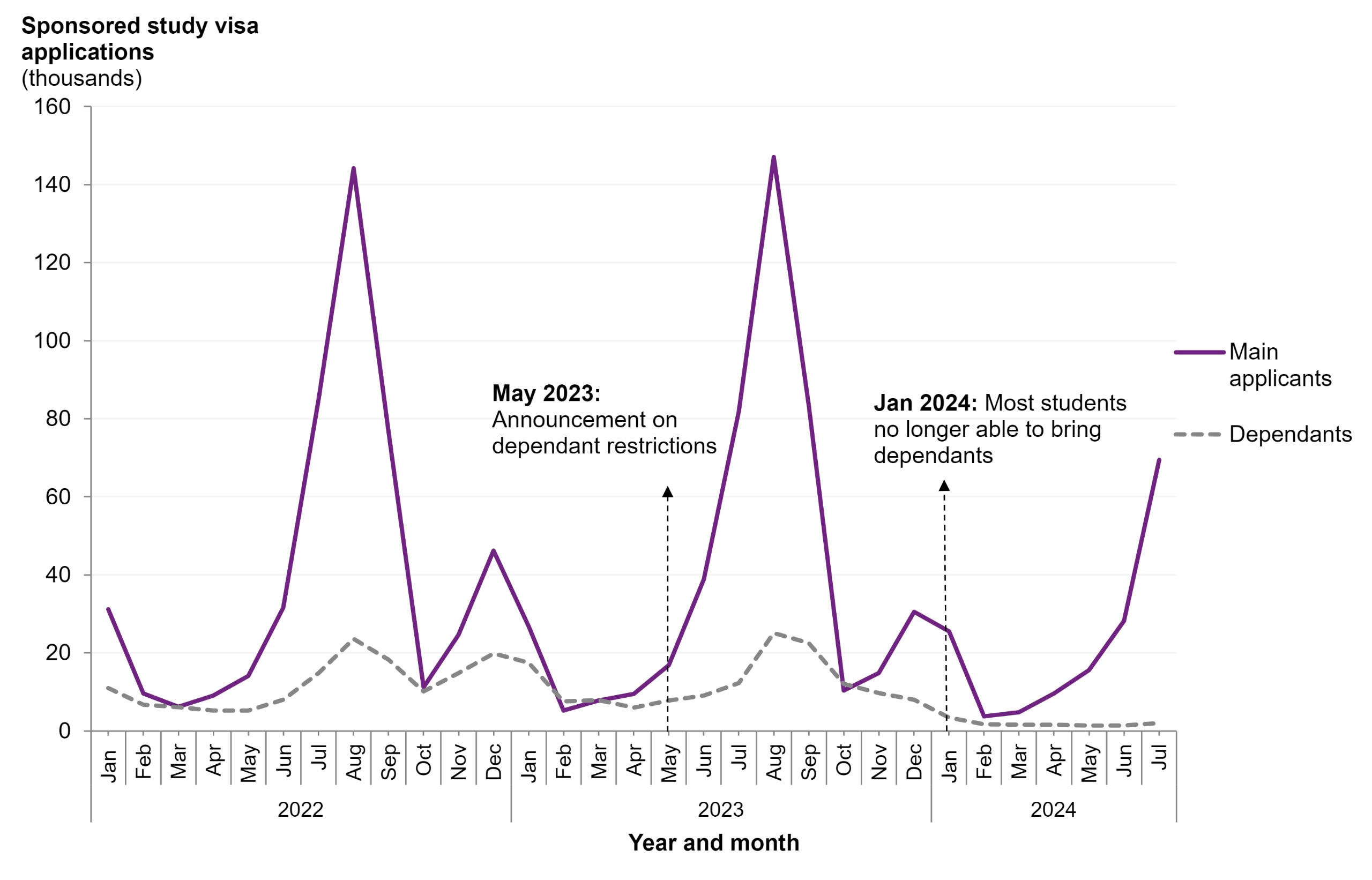
The number of UK student visa applications (shown by the purple line) over the last 3 years.
Predicted reduction in the number of international students by half.
The latest immigration data released by the UK Home Office on August 8th shows a significant drop in the number of international students wishing to study in the UK. Specifically, the number of student visa applications in July fell by approximately 15% compared to the same period in 2023, maintaining a continuous downward trend since the beginning of this year. Similarly, the total number of student visa applications from January to July (56,800 applications) also decreased by 16% compared to the same period last year.
However, the UK Home Office also noted in its report that the number of student visa applications typically peaks before the start of the new academic year, which is between July and September. Therefore, the agency believes that it is necessary to wait until after that period to fully assess the impact of the new policies introduced by the UK government this year, including restrictions on international students bringing family members and raising the standards for work visas.
The Guardian commented that, despite the high number of international students enrolling in 2022 and 2023, the situation in 2024 is not very promising. Rising inflation makes it difficult for universities to collect enough tuition fees from domestic students. Therefore, they become even more dependent on international students, who pay significantly higher tuition fees. The sharp decline in international students further exacerbates these difficulties for universities.
This has led some of the top UK universities, such as UCL, to expand their advertising efforts into non-traditional markets, even in the Caribbean such as Guadeloupe, Martinique, and Saint Martin, to attract students. Other universities, such as York, De Montfort, and Salford, have shifted their focus to countries in South Asia and Southeast Asia, according to The Telegraph .

International students at their graduation ceremony in May at University College London (UCL).
Some UK universities predict that the number of new international students will halve this year, especially in one-year postgraduate courses. A previous survey of 75 universities by the British Universities International Relations Association (BUILA) also indicated that 90% of institutions had received fewer applications for the autumn semester from international students than in 2023.
The goal is to reduce the number of immigrants.
Speaking to The Times , a spokesperson from the UK Home Office said the government has a detailed plan to reduce the record-high number of immigrants by addressing the root causes of excessive foreign labor recruitment and focusing on training domestic workers. "Immigration brings many benefits to the UK, but it must be controlled and done fairly," the spokesperson stated.
Previously, throughout the first few months of the year, the UK continuously adjusted its visa policy with the goal of reducing net immigration by 300,000 people annually. Measures included: raising salary requirements to secure sponsorship for workers to stay and work, restricting international students from bringing family members to the UK (except for those studying postgraduate research courses or government-funded courses), and shortening the list of eligible occupations.
These developments are making the UK increasingly less attractive to international students. Recent surveys from international education organizations such as IDP and AECC show that Australia, the UK, and Canada are no longer top choices for international students due to changes in international education policies regarding visas and work rights. Conversely, the US, Germany, and New Zealand are receiving more attention in the current context.
According to Higher Education Statistics (HESA), Vietnam ranked 20th in the number of international university students in the UK in 2022 with 7,140 students. This is the highest number recorded in the last 5 years. The cost of studying for a bachelor's degree in the UK ranges from £10,000 to £26,000 per year (308-800 million VND). For medical studies, tuition fees can reach nearly £68,000 (2 billion VND).
Source: https://thanhnien.vn/du-hoc-sinh-khong-con-man-ma-den-anh-18524081014315688.htm