
| Vietnam's textile industry moves up the knitwear supply chain; Vietnam Textile and Garment Group prepares to produce its first order of flame-retardant fabric. |
Many challenges
According to Mr. Truong Van Cam, Vice Chairman of the Vietnam Textile and Garment Association, textiles and garments are a key export industry, with annual turnover reaching approximately 40-45 billion USD, mainly exported to markets such as the US, EU, Japan, and South Korea. These are demanding markets with very high requirements for green products.
According to the leaders of the Vietnam Textile and Garment Association, the first step in producing green products is sourcing green raw materials and components. This is one of the challenges facing textile and garment businesses. Currently, the textile and garment industry imports over 70% of its raw materials and components, producing only about 30% domestically.
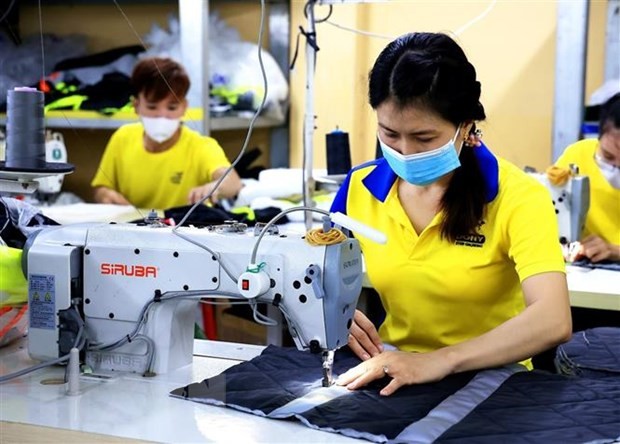 |
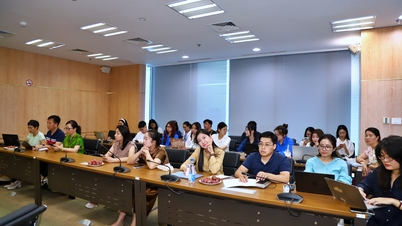
| Sustainable production: What challenges are textile and garment businesses facing? Photo: Dony |
“ Importing raw materials and knowing their origin, and whether they are environmentally friendly and safe, is extremely important. Therefore, traceability is necessary. However, this depends on the export method of the enterprise ,” Mr. Cam said.
" If domestic businesses choose raw materials or production on a buy-and-sell basis, they must pay close attention to verifying the origin of the materials. For example, where the cotton is produced, how the yarn is manufactured, and its structure. All these issues relate to clean raw materials and the production of clean, green products ," the leader of the Textile and Garment Association added.
To meet the green standards of importing markets, in recent years, domestic textile and garment businesses have developed environmentally friendly raw materials such as silk, pineapple fiber, banana fiber, seashells, coffee grounds, etc. In particular, businesses have planted large areas of ramie (5,000-6,000 hectares) in Thanh Hoa, Hoa Binh, Son La, Dien Bien , etc., which will be a source of green raw materials for production. However, developing a sufficient scale of raw materials to serve export production requires enormous investment capital, which is also a major challenge for businesses.
Expert recommendations
Sustainable production and the development of green products are irresistible trends. Aware of this, since the beginning of 2018, the Vietnam Textile and Garment Association has introduced the PPP model (P - the enterprise must develop green products but also be profitable; P - the textile and garment industry lacks labor and cannot produce; P - environmental protection).
The association itself has also collaborated with many international organizations to hold workshops and training sessions to raise awareness among both employers and employees about sustainable development.
“ With approximately 85% being small and medium-sized enterprises, domestic textile and garment businesses have diverse resources available for green and sustainable production. Therefore, green production cannot be pursued at all costs but needs to be implemented appropriately according to the resources of each enterprise and with suitable steps. Only in this way can businesses ensure both survival and development while meeting green and clean requirements ,” Mr. Cam analyzed.
To avoid falling behind the global trend of green production and consumption in the textile and garment market, the leaders of the Vietnam Textile and Garment Association believe that, first and foremost, businesses must be self-sufficient in raw materials and auxiliary materials.
Regarding this, Mr. Cam added that the Strategy for the Development of Vietnam's Textile, Garment, and Footwear Industry until 3030, with a vision to 2035, includes a very important content: the establishment of large textile, garment, and footwear complexes with businesses and investors possessing advanced technology. Only such large complexes can concentrate sufficient water resources to build a central wastewater treatment plant and reuse the wastewater for businesses within the industrial park.
“ The Tam Thang Industrial Park in Quang Nam has collected and treated about 80% of its wastewater, which is then reused at a cost 15-20% lower ,” Mr. Cam said.
At the same time, installing rooftop solar power allows for the buying, selling, exchanging, and use of clean energy.
On the other hand, greening production and products requires significant funding. Businesses hope the government will have policies on green credit and provide certain support in terms of interest rates and human resource training to help them develop green transformation plans.
Agreeing with the above viewpoint, Mr. Mac Quoc Anh, Vice Chairman and General Secretary of the Hanoi Small and Medium-sized Enterprise Association, expressed: A tax policy that is suitable for businesses transitioning to green and sustainable production is very important.
Currently, VAT has been reduced by 2%, to 8% for all businesses. Therefore, for green manufacturing businesses, the government could consider further reducing other taxes such as energy consumption tax and fuel tax to stimulate even stronger investment.
Whether businesses successfully transition to green production is also linked to sustainable consumption. Accordingly, in the domestic market, experts also believe that, in addition to public awareness campaigns, retail systems need effective solutions to help consumers clearly identify green products and how to use them.
Source: https://congthuong.vn/san-xuat-ben-vung-dieu-gi-dang-lam-kho-doanh-nghiep-det-may-336208.html