
The global stock sell-off intensified on August 5th, with the Dow Jones Industrial Average falling more than 900 points at the open and Japan's Nikkei 225 index recording its biggest single-day drop ever.
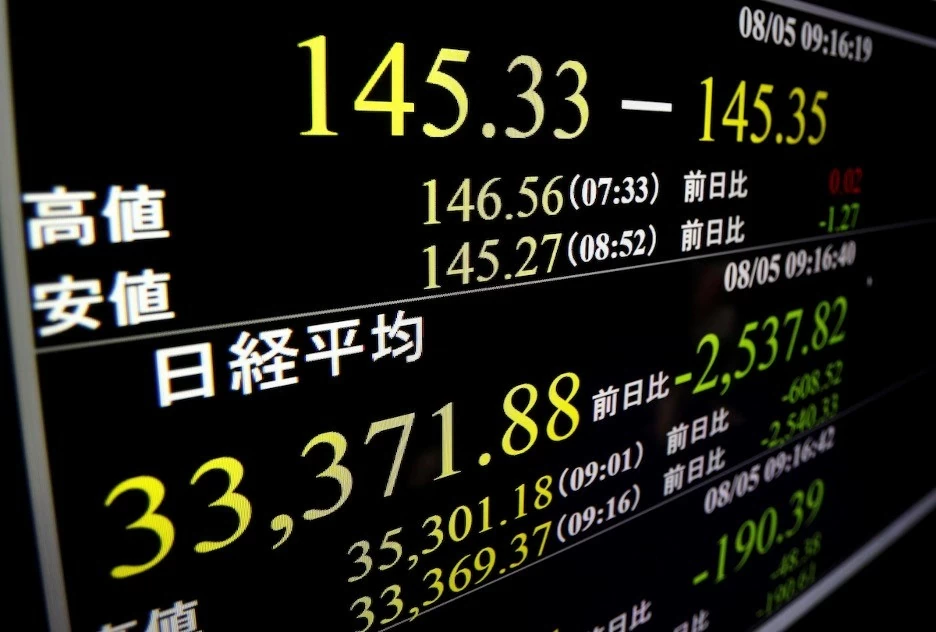 |
| A screen in Tokyo displays the Nikkei 225 stock index on the 'Black Monday' of global stock markets. (Source: AP) |
Global stock market news reports indicate that today's trading day was a dark one, fueling heightened fears of an economic recession. Besides the US Dow Jones index falling sharply by about 3%, the S&P 500 and Nasdaq Composite also plummeted by approximately 4% and 6%, respectively.
The main cause of this crisis is the US July jobs report, released last week, which was much lower than expected. This figure has raised concerns about the possibility of the world's largest economy falling into recession.
Japan's Nikkei 225 index was even harder hit, falling more than 12%, its sharpest decline since 1987. Technology stocks were also heavily impacted, with NVIDIA shares dropping more than 14% and Apple shares falling more than 8%.
“Investors are experiencing global pain,” said Dan Ives, managing director of equity research at investment firm Wedbush. He added that the US market is “trading in the red broadly.”
The US jobs report for July showed only 114,000 new jobs were created, far below economists' forecasts of 185,000. The unemployment rate rose to 4.3%, the highest level since October 2021.
The rapid increase in the unemployment rate from 3.7% to 4.3% this year has triggered the “Sahm Rule,” an indicator of economic recession. This rule states that a 0.5 percentage point increase in the unemployment rate over 12 months typically signals an impending recession.
On August 4th, Goldman Sachs economists raised the probability of a US economic recession next year from 15% to 25%.
Amidst this tense situation, investors are calling for the Federal Reserve (Fed) to make a sharp interest rate cut at its next meeting in September. Some investors are even demanding an emergency rate cut this week.
This is an unprecedented move, but it reflects the level of concern about the current economic situation. Cutting interest rates could help stimulate the economy and support the stock market. However, the final decision rests with the Fed and will depend on various factors.
Amidst significant volatility in global financial markets, investors need to closely monitor economic developments and monetary policies to make informed investment decisions.



The sharp drop in stock markets and fears of an economic recession are causing instability in the global economy. Governments and central banks need to take timely measures to prevent the situation from worsening.
This is a challenging period for the global economy, and its impact will be felt in the coming months.
Source: https://baoquocte.vn/ngay-thu-hai-den-toi-cua-thi-truong-chung-khoan-toan-cau-ap-luc-giam-lai-suat-tang-cao-noi-lo-suy-thoai-kinh-te-gia-tang-281463.html