
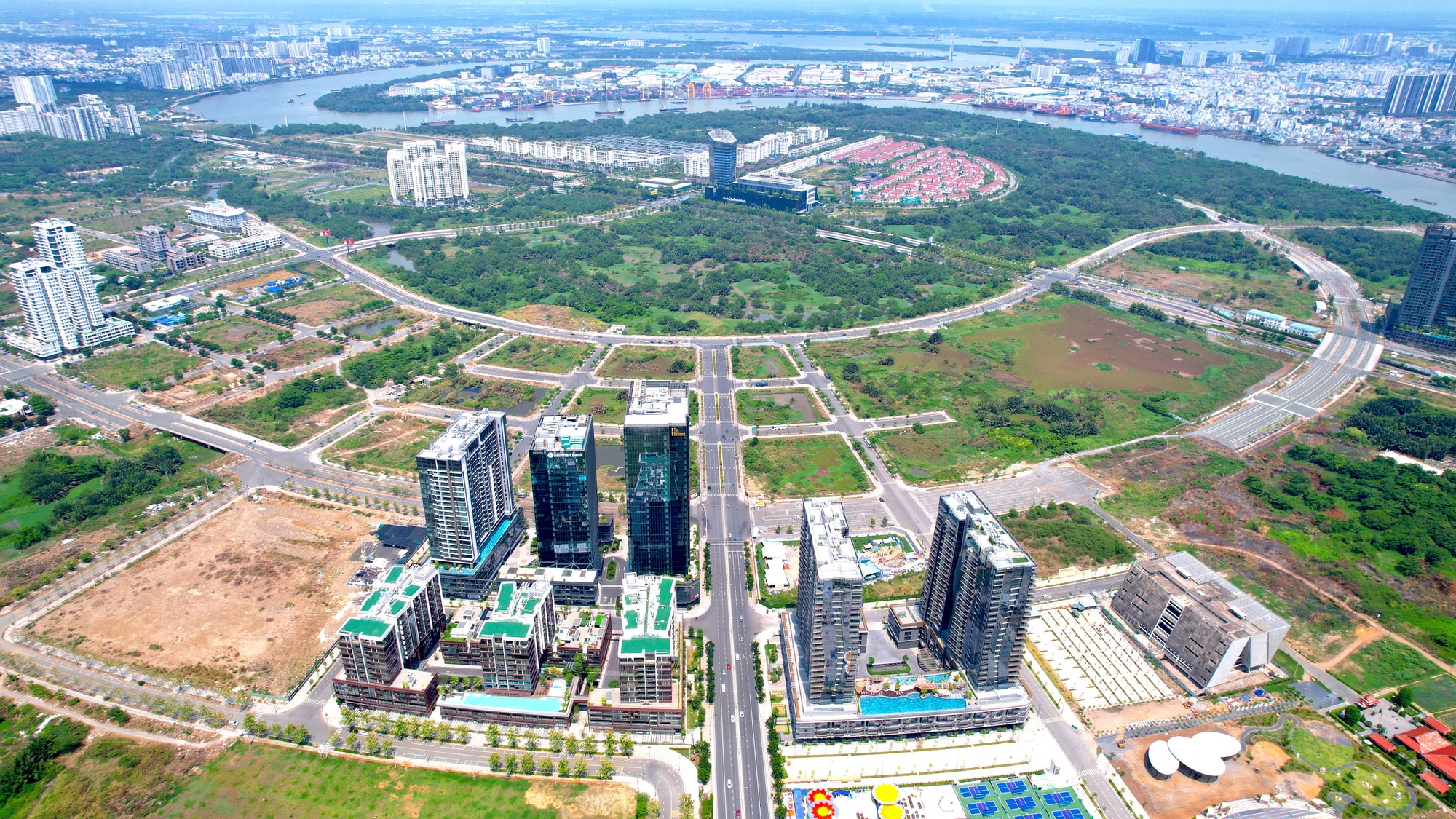
Businesses believe that accurate and comprehensive land valuation will help resolve bottlenecks in the valuation process, thereby revitalizing the real estate market. - Photo: NGOC HIEN
Are interest expenses and developer profits being calculated lower than they actually are?
The Law on Real Estate Business, which came into effect on August 1st, stipulates that to implement a project, the investor must have a minimum capital of 15% or 20% of the total construction investment cost. The remaining amount must be raised by the investor through bank loans and from customers.
Regarding the payment process in the purchase and lease-purchase of future-built real estate, the law stipulates that developers can only raise capital after the foundation (for apartment buildings) is completed, and the initial payment for future-built housing cannot exceed 30% of the contract value. Therefore, the loan-to-value ratio from banks for real estate projects ranges from 50-70% of the total construction investment cost.
According to businesses in Ho Chi Minh City, if the medium-term loan interest rate is 12% per year, interest expenses will account for 6-9% of the total construction investment costs. Meanwhile, Decree 71 on land valuation, recently issued, assumes that interest expenses and investor profit are calculated as 15% multiplied by the total construction investment costs, business expenses, and land use rights value.
According to a business leader, Decree 71 stipulates that both interest expenses and profit are "applied" at an assumed figure of 15%. This means that if interest expenses are calculated at 6-9%, the investor's profit would be approximately 6-9% of the total construction and land investment costs.
"Clearly, the profit margin is lower than the projected profit for social housing development. If the investor's profit margin were higher, the interest expense would decrease, which would be much lower than the actual rate, considering that many businesses are currently borrowing for real estate projects at interest rates of 10-14% per year," this person said.
Unified regulations are needed.
According to experts, although the appendix to the decree stipulates figures for illustrative purposes only and not applicable in practice, the 15% ratio still raises concerns among the project development community.
A developer of several real estate projects in the South (who requested anonymity) said that when the decree is implemented, the enforcement agencies will be influenced by the percentage figures given in the decree's appendix, which compare interest costs and investor profits.
Therefore, when the attached appendix stipulated a 15% ratio, local authorities and land valuation consulting units were hesitant and influenced by the 15% figure, failing to set a different ratio that was more in line with market conditions.
Meanwhile, a major valuation firm in Ho Chi Minh City stated that although there is a decree and examples of hypothetical application rates, valuation firms hope that the Ministry of Natural Resources and Environment will issue official regulations on these rates for consistent application, while also aligning them with the actual operations of businesses.
According to this unit, accurately calculating the interest rate and investor profit margin when determining land prices, as well as other reasonable costs, will solve the long-standing problem of land valuation.



According to businesses, the investor's profit typically falls within 15-20% of the total construction and land costs, while interest expenses account for 6-9% of the total construction costs. Therefore, interest expenses and the investor's profit together account for 21-29% of the total construction and land costs.
According to many businesses, interest expenses and the developer's profit margin should be set at 21-29%. If the calculation is too low and does not reflect reality, it will continue to lead to a vicious cycle of land valuation, causing project development costs to increase significantly.
"Only by accurately, fully, and reasonably recording the actual costs of businesses can we fully realize the value of the new laws and decrees on real estate, unlocking the bottlenecks for the entire market and removing difficulties for businesses, helping to increase supply," shared the leader of a real estate company.
Source: https://tuoitre.vn/lo-ap-chi-phi-thap-hon-thuc-te-doanh-nghiep-de-xuat-ti-le-chung-khi-dinh-gia-dat-2024080720214113.htm