
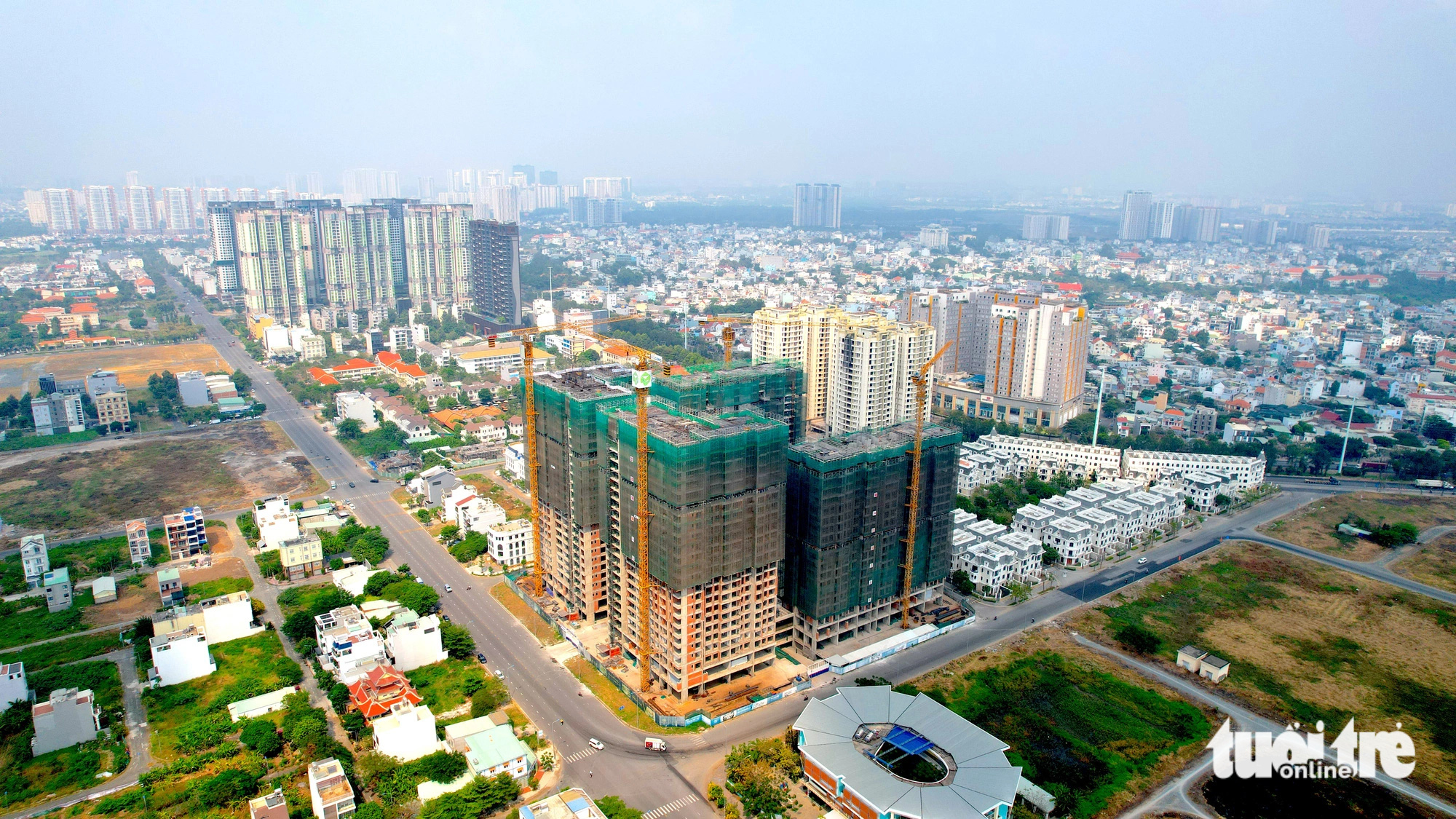
Large inventories mean that real estate businesses have to bear the costs of preservation, financing, and the risk of depreciation - Photo: NGOC HIEN
Reports indicate that the real estate market is gradually recovering, but the burden of unsold inventory continues to weigh heavily on businesses.
Many real estate companies have inventory accounting for 50% of their assets.
Although the market showed signs of improvement in the early months of the year, inventory levels continued to increase, especially for projects facing legal issues or products that did not meet market demand.
Novaland 's financial report shows that as of June 30th, its inventory had increased to VND 142,024 billion, compared to only VND 138,935 billion as of December 31st, 2023. Within Novaland's inventory structure, nearly VND 134,000 billion consists of properties for sale that are under construction, and 8,380 properties for sale that have been completed.
Meanwhile, as of the end of June, Novaland's total assets amounted to VND 240,178 billion, meaning inventory accounted for more than half of the company's total assets.
Another major real estate company, Vinhomes, also has inventory worth VND 56,311 billion as of June 30th, a slight increase compared to the end of last year when inventory was VND 55,318 billion as of December 31st, 2023. Of this, inventory of properties under construction is VND 48,618 billion. With total assets of VND 494,460 billion, Vinhomes has a high inventory value but a low percentage of total assets, at just over 11%.
In the Southern market, Nam Long Real Estate had inventory of VND 19,164 billion in the first half of the year, an increase of nearly VND 2,000 billion compared to the end of last year (VND 17,352 billion). With total assets reaching VND 29,731 billion, Nam Long's inventory accounts for more than 64%.
Specializing in housing development in Ho Chi Minh City, Khang Dien Group also has a high inventory level, reaching VND 21,458 billion, compared to only VND 17,786 billion at the end of last year. As of June 30th, Khang Dien's total assets reached VND 28,401 billion, with an inventory ratio of 75%.
Meanwhile, Phat Dat Real Estate also saw a slight increase in inventory, reaching VND 12,523 billion as of June 30th, compared to VND 12,199 billion at the end of last year. This inventory accounts for more than half of Phat Dat's total assets as of the end of Q2 2024 (VND 22,536 billion).
Dat Xanh Group's inventory reached VND 13,896 billion, a slight decrease compared to the end of last year, but still accounting for 47% of the company's total assets (VND 28,955 billion).
Don't let excess inventory become a "blood clot."
Mr. Le Hoang Chau, chairman of the Ho Chi Minh City Real Estate Association, believes that inventory is normal if it is part of a company's business plan and strategy. The worrying issue with inventory is when products that have been built and sold on the market are not accepted by the market, meaning they have low liquidity.
According to Mr. Chau, large inventories for weak businesses that use high financial leverage will create a mountain of debt weighing on the company's shoulders; without liquidity, the business will face difficulties.
Meanwhile, the director of a real estate business in Ho Chi Minh City argued that the inventory figures for listed companies do not fully reflect the market because a large amount of real estate remains "dormant" in unlisted companies and secondary investors, making inventory a "blood clot" for the market.



The director pointed out that even on the books of listed companies, this inventory figure doesn't fully reflect its true nature. In reality, some real estate companies have sold to secondary companies, accounting for no remaining inventory, but in fact, this is inventory being transferred to other companies, posing many risks to the economy .
Therefore, this expert believes it is crucial for project development companies to restructure their products and pricing to increase liquidity and avoid a continuous increase in inventory, which would lead to higher non-performing loan ratios and reduced credit safety.
Mr. Nguyen Van Dinh, Vice Chairman of the Vietnam Real Estate Association, believes that developers need to restructure product pricing to be more appropriate, even accepting a "sacrifice" of some profit to sell their properties. According to Mr. Dinh, many real estate projects have been underway for years but remain unfinished due to legal obstacles. Therefore, relevant authorities need to continue resolving these issues and help projects complete their legal procedures so they can begin selling.
Source: https://tuoitre.vn/doanh-nghiep-bat-dong-san-dang-om-hang-ti-usd-hang-ton-kho-20240807194113496.htm