
To have more "shining gems" on the stock market.
After 24 years of operation, the Vietnamese stock market has not only expanded in size but has also become a channel for capital flow, accompanying the development of businesses. However, the market lacks new investment options and needs more mechanisms to encourage good companies to list.
Market shifts
During the Q2/2024 financial reporting season, Rang Dong Light Bulb and Thermos Flask Joint Stock Company became a notable highlight, recording impressive year-on-year revenue and profit growth of 39% and 23% respectively. Earnings per share (EPS) also surged to nearly VND 14,100, placing it in the top 5 companies with the highest 6-month EPS across all three stock exchanges.
Having completed its equitization process in 2004 and listed on the Ho Chi Minh City Stock Exchange two years later, Rang Dong has witnessed many changes over the past 20 years. Sales revenue in 2023 was 20 times higher, and realized profits were 49 times higher than before equitization. From its iconic Rang Dong thermos flask, remembered as a "legendary" wedding gift, contributing to current quarterly revenue of 2,000-3,000 billion VND, the company's product portfolio has expanded significantly. Growth is driven by smart lighting projects and the integration of technology into solutions for high-tech agriculture and fisheries.
On the Vietnamese stock exchange, half of the approximately 1,800 listed and registered companies are state-owned enterprises that have undergone privatization. Not only Rang Dong, but many of these companies have expanded their production and business operations, developed further than before going public, and even successfully raised capital at reasonable and sustainable costs through the stock market.
 |
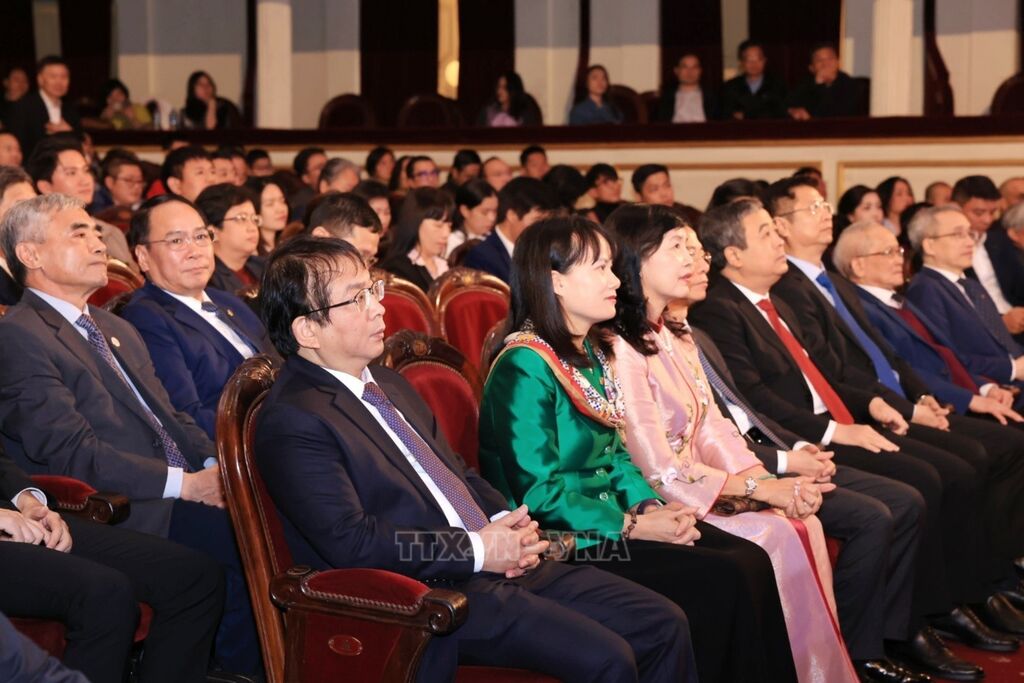
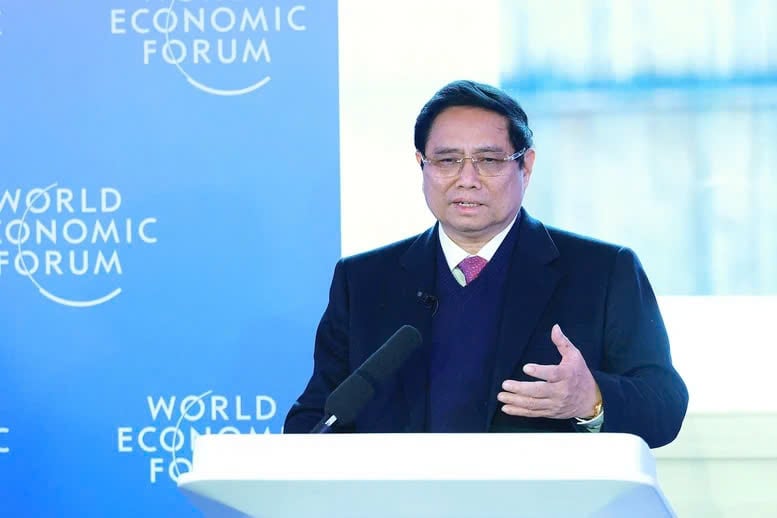
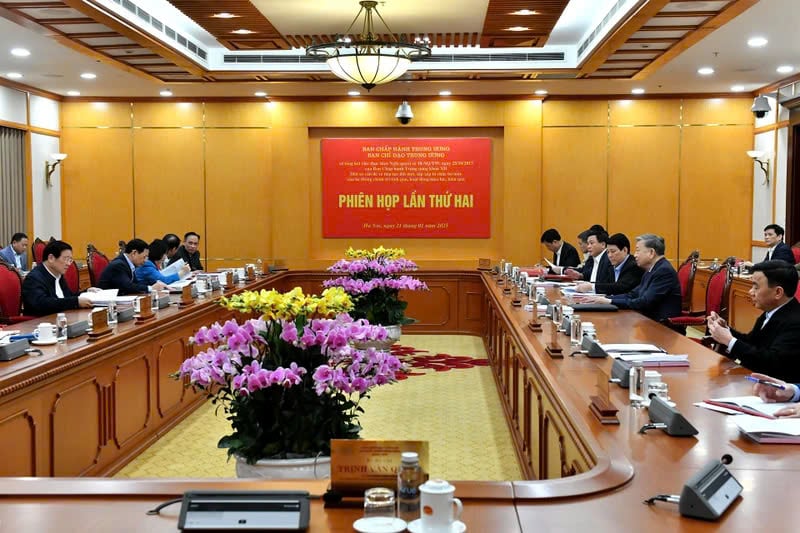
| Delegates exchange views at the seminar "Vietnam Stock Market: New Driving Forces, New Opportunities" organized by Investment Newspaper. Photo: Dung Minh |
At Rang Dong, with an offering price of 93,000 VND per share, many times higher than the par value, the 2021 share issuance to existing shareholders helped raise over a trillion VND, supplementing resources for factory investment and expanding production capacity.
Refrigeration and Electrical Engineering Corporation (REE Corp) - a pioneering enterprise to be listed on the stock exchange in its first trading session (July 28, 2000), has carried out a total of 8 share issuances, raising 2,800 billion VND for investment and development.
Speaking at the recent seminar "Vietnam Stock Market: New Driving Forces, New Opportunities" organized by Investment Newspaper, Mr. Bui Hoang Hai, Vice Chairman of the State Securities Commission (SSC), pointed out three major values that the 24-year-old market contributes to the economy .
Firstly, the stock market has provided strong support for the equitization process, improving the operational efficiency of state-owned enterprises.
Secondly, Vietnam would find it difficult to have as many large economic groups, ranking among the top 500 in Southeast Asia as it does today, if it relied solely on initial capital contributions from shareholders or bank loans.
Thirdly, in line with the development of the times, the stock market provides requirements and incentives for businesses to grow qualitatively as they aim for sustainable development.
“Over the past 24 years, the stock market has been a place where the spirit of fair and transparent business practices has been disseminated. With encouragement from policies, the market has also influenced production and business activities towards increased social responsibility and the implementation of ESG standards, thereby contributing to the sustainable growth of the economy,” Mr. Hai emphasized.
Add mechanisms to encourage "shining gems"
After 24 years of operation, although still relatively young compared to some regional markets such as the Philippines and Thailand, the Vietnamese stock market has matured not only in terms of market capitalization (currently around 300 billion USD), but also in the number of investors and market liquidity. The number of listed securities has now reached 1,800.
 Recently, domestic growth has been slow, and credit growth has not met expectations, causing Vietnam's overall growth to fall short of targets. I have a feeling that some investors are still hesitant, leading to reduced investment. However, the current global situation is favorable for Vietnam. I believe that people and businesses should invest boldly.
 Vietnam is peaceful and a major exporter to the world. While major powers are locked in a fierce geopolitical struggle, Vietnam is fortunate to have its own "way out" thanks to its advantageous position in the trend of investment relocation. 
Mr. Dang Thanh Tam, Chairman of the Board of Directors of Kinh Bac Urban Development Corporation - JSC
Of these, the number of companies listed on the UPCoM exchange is slightly higher, with only 729 stocks and fund certificates on the HoSE and HNX. The trend of transferring to a different exchange has been an interesting "catalyst" driving stock price growth for many years, but only a relatively modest number of companies have actually done so. Many large companies on the UPCoM exchange are leading companies in their respective industries, with good business performance and plans to list on the main exchange, but have yet to realize this goal. For example, Binh Son Refining and Petrochemical Joint Stock Company (BSR) met 8 out of 9 listing requirements, with profits and return on equity (ROE) significantly higher than needed, but still faced obstacles due to overdue debts from its subsidiary.
Based on observations from the regulatory agency, Mr. Hai stated that this partly stems from the company's own will and partly from the fact that the company has not yet met the standards for listing on a different exchange. Regarding BSR's case, Mr. Hai added that the company itself has a plan to address the issue.
Besides the issue of listing on different exchanges, in recent years, initial public offerings (IPOs) and new listings have been very quiet. According to Ms. Le Thi Le Hang, Director of Strategy at SSI Securities Company, a limitation frequently pointed out by foreign investors is the lack of new options in the market. Even if foreign investors want to allocate more funds, they will have to wait for new "goods" or for more foreign ownership limits to be available.
In an effort to encourage businesses to go public, the State Securities Commission of Vietnam (UBCKNN) is reviewing regulations and plans to amend Decree 155/2020/ND-CP to integrate IPO and listing activities. According to Mr. Hai, after the regulations are amended, businesses can list almost immediately after conducting an IPO, much shorter than the current 3-month period. This change will remove the barrier when investors who buy shares from an IPO cannot trade them immediately.
The trend of listing subsidiaries under their parent companies on the stock exchange has been announced by many businesses at this year's annual general meetings, such as Masan Consumer's IPO plan, Vinpearl's listing, and most recently, MocChau Milk's completed listing transfer. BCG Energy - a subsidiary of Bamboo Capital Group - has also been approved for trading on UPCoM… These developments are expected to bring new stories to the market.
An incentive mechanism to bring more high-quality "goods" to the market is necessary, thereby expanding investment options to not only attract and retain foreign capital, but also draw more domestic capital attention to the market, given the opportunity for Vietnam's stock market to be upgraded from a frontier market to an emerging market.
We need consensus.
In the draft circular amending four previous circulars, in order to promote the upgrade process, besides solutions to facilitate transactions for foreign institutional investors by removing the margin requirement bottleneck, another important content is to create conditions for foreign investors to have equal access to information. To achieve this, changes are needed from the listed companies themselves.
According to the roadmap, listed organizations and large-scale public companies are expected to simultaneously disclose information in English starting from January 1, 2025, initially with periodic information and continuing to add extraordinary information from the beginning of 2026.



This regulation is applied in many countries and is also encouraged in Vietnam. However, in reality, to date, only about 80 businesses have published information in English, mostly concentrated in the export sector and large enterprises.
Implementing widespread English-language disclosure is not an easy task. However, just as in the early stages of the market, the demand for transparency was once a pressure, but it was this pressure that shaped the generation of listed companies we see today.
Recently, the VNCG50 Initiative – which brings together 50 pioneering Vietnamese businesses committed to ensuring good corporate governance practices, aiming to narrow the gap in corporate governance between Vietnam and ASEAN – was announced. Some pioneering businesses are ready to go beyond mere compliance in their corporate governance practices, pursuing a broader goal for the development of their enterprises.
Having been involved in the market since its early days, Ms. Nguyen Thi Mai Thanh, Chairwoman of the Board of Directors of REE Corp, believes that the stock market is a place that "temples" listed companies to conduct business more honestly, transparently, and responsibly, while also honing professional managers and striving to maintain the company's value continuously increasing.
Besides the increasingly stringent requirements of being part of the stock market, businesses are facing challenges from the uncertainty of the business environment.
For many years, the global economy has faced numerous uncertainties, posing greater challenges for business leaders. From the perspective of a listed company operating in the industrial real estate sector, with opportunities to interact with investors from many countries, Mr. Dang Thanh Tam, Chairman of the Board of Directors of Kinh Bac Urban Development Corporation - JSC (KBC), feels the whirlwind of fierce economic competition in major markets. However, according to him, Vietnam still has opportunities to expand investment and markets. Based on existing foundations, active export activities, and a stable political, social, and macroeconomic situation, Vietnamese businesses can leverage these opportunities and invest more boldly to benefit from economic trends.
Source: https://baodautu.vn/de-co-nhieu-hon-nhung-vien-ngoc-sang-tren-san-chung-khoan-d220816.html