

Is a "final" ceasefire agreement for the Gaza Strip imminent?
President Biden and the leaders of Egypt and Qatar said on August 8 that they were prepared to offer a "final" ceasefire proposal to end the war in the Gaza Strip, and called on Israel and Hamas to return to the negotiating table next week to resolve the conflict.
In a joint statement, Biden, along with Egyptian President Abdel Fattah el-Sisi and Qatari Emir Sheikh Tamim bin Hamad al-Thani, declared that "it is time" to finalize the ceasefire and release hostages abducted since October 7 last year, as well as Palestinians held captive by Israel.
The three leaders stressed that negotiators will meet in Cairo (Egypt) or Doha (Qatar) next Thursday, August 15th.
"There is no more time to waste or any excuse for further delay," the three leaders said in a joint statement. "It is time to release the hostages, begin a ceasefire, and implement this agreement. As mediators, if necessary, we are prepared to present a final bridging proposal that addresses the remaining implementation issues in a way that meets the expectations of all parties."
Ceasefire talks have stalled after last weekend's meeting in Cairo failed to achieve a breakthrough, and the process has been further complicated by the assassination of Hamas political leader Ismail Haniyeh, who had been leading the negotiations through intermediaries.
Just minutes after the joint statement by Biden and the aforementioned leaders, Israeli Prime Minister Benjamin Netanyahu agreed to "send a negotiating delegation to any location decided on August 15th to finalize the details of implementing the framework agreement," Netanyahu's office said.
But it is unclear how willing Israel and Hamas are to reach an agreement. Hamas did not immediately respond to the joint statement by the leaders of the US, Egypt, and Qatar.

Dirt and dust rise along with black smoke during an airstrike on al-Zawayda, Gaza Strip. Photo: Getty Images
Reporting from Amman, Jordan, Al Jazeera correspondent Hamdah Salhut stated that any future negotiations would be complicated because "there are many dynamic factors at play," particularly the risk of retaliatory attacks from Iran or one of its proxy forces, or both.
Additionally, reporter Hamdah Salhut noted that the Israelis will now negotiate with Yahya Sinwar, the new political leader of Hamas, replacing Haniyeh.
"Mr. Sinwar is seen as a hardliner. Mr. Netanyahu is also seen as a hardliner. This could lengthen the list of non-negotiable issues in negotiations between the two sides."
The F-22 Raptor "Bird of Predator" has arrived in the Middle East.
U.S. Air Force F-22 Raptor fighter jets are currently in the Middle East "to address threats posed by Iran and Iranian-backed groups" to Israel and U.S. forces in the region, the U.S. Central Command (CENTCOM) announced on August 8.
The Pentagon has deployed additional forces to the region after Iran vowed revenge for the assassination of Haniyeh. Tehran and Hamas claim Israel is responsible, while Tel Aviv has remained silent on the assassination.
The retaliation that Tehran has declared could include direct attacks from Iranian territory and indirect attacks through its proxy forces. Lebanon's Iranian-backed Hezbollah, which controls southern Lebanon and the Lebanese border with Israel, could also carry out attacks.
In recent weeks, U.S. forces in Iraq and Syria have been subjected to missile attacks from proxy forces there.
Recently, a missile attack on Al Asad Air Base in Iraq on August 5 injured four US servicemen and a US contractor, the Pentagon said on August 8, attributing the attack on Al Asad to a Shia militia group linked to Iran.
According to the Pentagon, since October, when conflict between Israel and Hamas flared up again in the Gaza Strip, there have been 180 attacks targeting US troops in Iraq, Syria, and Jordan.
Regarding the F-22 Raptor fighter jet, it is the most advanced combat aircraft among the new forces rapidly deployed by the US to the region, including warships capable of firing and intercepting ballistic missiles. The US may also be strengthening land-based ballistic missile defenses in the region.
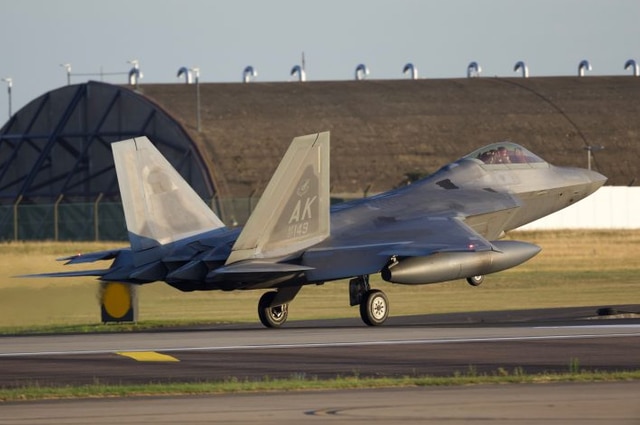
A US Air Force F-22A Raptor stealth fighter jet, flying from Alaska to the Middle East, makes a stopover at Lakenheath Air Force Base in the United Kingdom. Photo: The Aviationist
Approximately a dozen F-22s have arrived at a base in the Middle East from Joint Base Elmendorf-Richardson, Alaska, U.S. officials told Air & Space Forces magazine on August 8.
Traveling over 5,600 nautical miles (over 10,300 km), the "Birds of Prey" made their journey across North America and the Atlantic, stopping at Lakenheath Air Force Base in the United Kingdom, before moving across the Mediterranean Sea. They reached their temporary base in the region on August 8th with the help of refueling aircraft.
A spokesperson for Air Forces Central (AFCENT) declined to say where the F-22s or any other U.S. fighter jets in the area were deployed, citing security reasons.
Minh Duc (Based on NY Times, GZero Media, Air & Space Forces, Al Jazeera)
Source: https://www.nguoiduatin.vn/tinh-hinh-trung-dong-ngay-9-8-chim-an-thit-f-22-raptor-da-co-mat-204240809125756953.htm