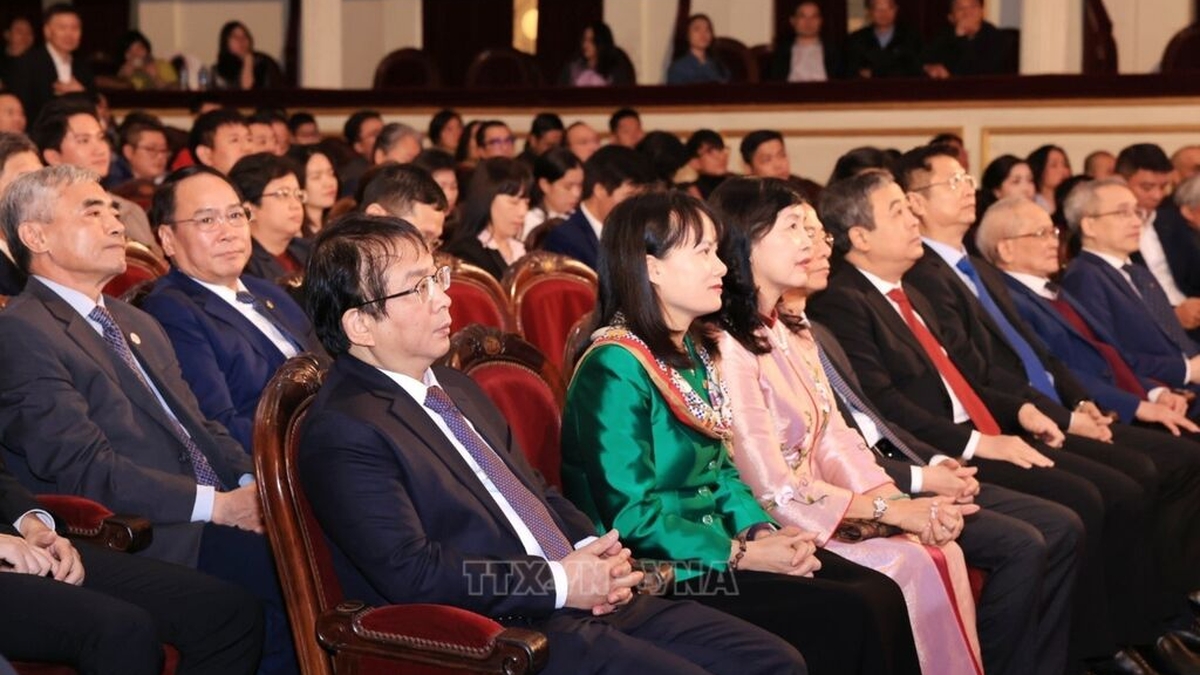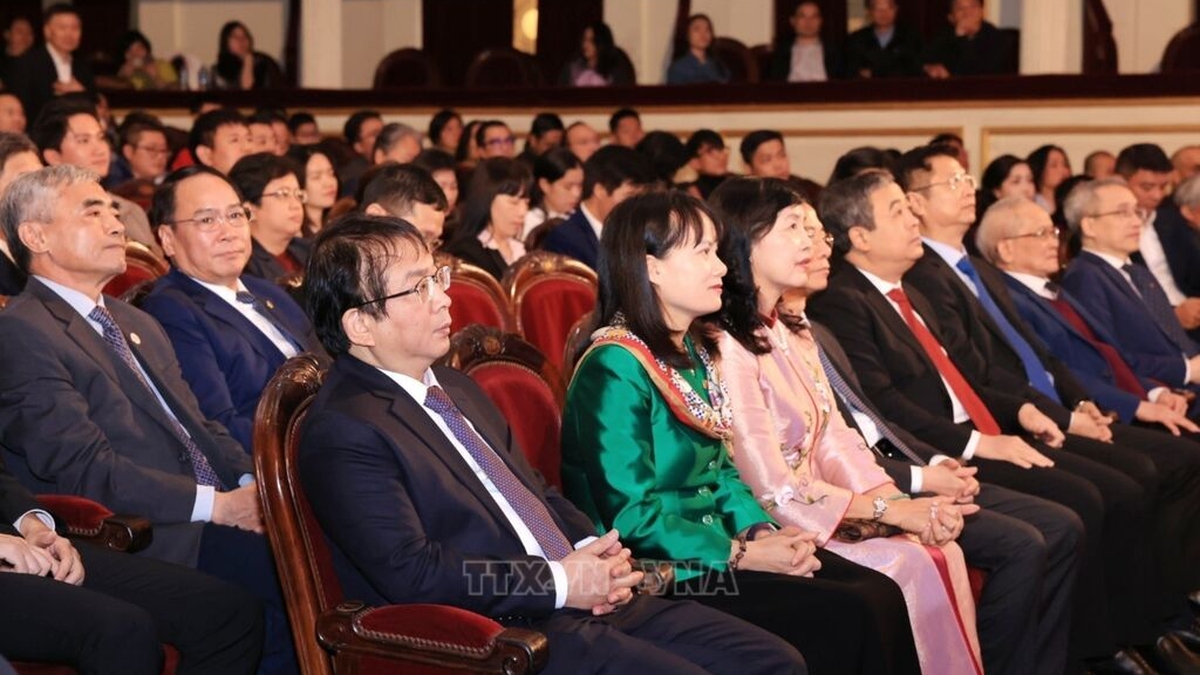

General Secretary To Lam 's article "Lifelong Learning" ushers the lifelong learning movement into a new phase.
Last week, the People's Representatives Newspaper continued to publish in-depth interviews about General Secretary To Lam's article "Lifelong Learning".
Professor Pham Tat Dong, advisor to the Vietnam Association for the Promotion of Learning, believes that General Secretary To Lam's article on "Lifelong Learning" has helped to provide clearer direction, leading the lifelong learning movement into a new phase: the phase of digital transformation and green transformation.
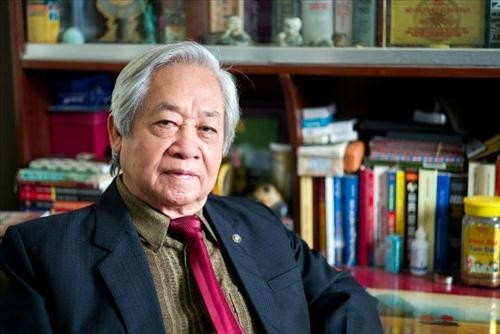
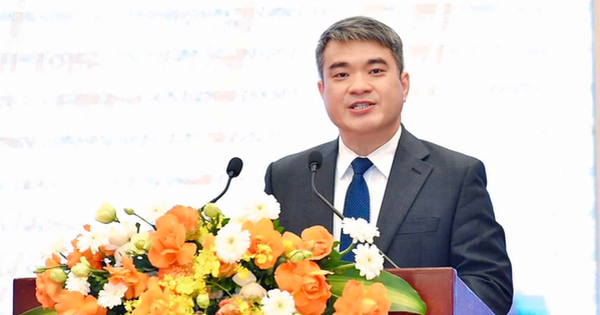
Prof. Dr. Pham Tat Dong - Advisor to the Vietnam Association for the Promotion of Learning
According to Professor Pham Tat Dong, we have entered a new phase. The Vietnam Association for the Promotion of Learning has also made preparations, and to date, most local branches have connected to the network and accomplished a great deal. Community learning centers in some places, such as Thai Binh, have begun organizing online classes. I highly appreciate General Secretary To Lam's article on "Lifelong Learning," as it has helped us to better orient ourselves for this new phase.
Following the General Secretary's affirmation that promoting lifelong learning will help us "successfully build a team of cadres with high qualifications, capabilities, good moral character, aspirations for advancement and development, who dare to think, dare to act, and dare to take responsibility for their decisions to realize revolutionary tasks, create breakthroughs for the benefit of the people, and for the development of the country," Professor Pham Tat Dong emphasized that to dare to think, dare to sacrifice, dare to dedicate oneself, and dare to do great things, one must first "dare to learn."
The most important thing is to dare to overcome yourself, to step outside your "comfort zone" to learn, and then dare to act on what you have learned.
In reality, learning, like any other task, is always difficult at the beginning. But once you get through the initial stage, you'll realize that learning isn't scary. If you try to maintain it a little each day, learning will gradually become a habit. Once you've formed a learning habit, you'll discover many valuable things, and from there, you'll realize how much better you can do.
Those who "dare to sacrifice, dare to fight" are those who understand this well; they dare to think, dare to act, and act intelligently, with knowledge of the law, culture, expertise, and even customs and traditions. All of these things can only be acquired through learning. Therefore, learning remains the foundation of daring to think and daring to act...
Read the full interview with Professor Pham Tat Dong by the People's Representatives Newspaper here.
We propose increased investment in local human resource training facilities.
On the morning of March 13th, the Supervisory Delegation of the National Assembly Standing Committee worked with Hai Duong University and a number of higher education and vocational education institutions in Hai Duong province on the implementation of policies and laws in the development and utilization of human resources to meet the requirements of socio-economic development, especially high-quality human resources, in the period 2021-2024.
During the meeting, Hai Duong University proposed that the Government and relevant ministries and agencies continue to develop and issue policies to support local higher education institutions in increasing investment in infrastructure development for training, especially in fields where the locality needs high-quality human resources such as automation, semiconductor technology, artificial intelligence, electrical engineering, and logistics. They also requested the restoration of college-level training programs at higher education institutions to facilitate articulation between different levels of education.
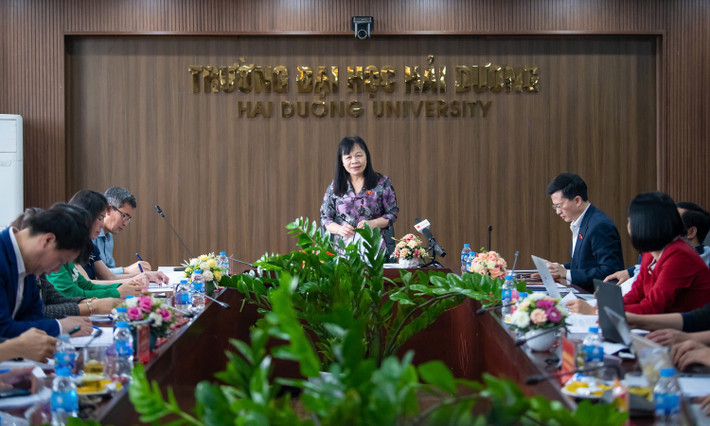
Currently, Hai Duong University offers 28 majors across 5 fields, including 25 undergraduate programs, 1 associate degree program, and 2 master's degree programs. The total number of students across all programs at the university is 3,266.
The monitoring team acknowledged the efforts of higher education and vocational training institutions in Hai Duong province in training and developing human resources to meet the requirements of local socio-economic development. Reports and discussions showed that the schools are also ready to overcome challenges and seize opportunities.
While affirming the responsibility of higher education and vocational education institutions, whether local or located within a locality, for human resource development, Deputy Chair of the Committee on Culture and Social Affairs Nguyen Thi Mai Hoa also stated that, in order to be autonomous and train to meet the needs of the labor market, educational institutions need the attention and support of the State, and the responsible participation of society, especially businesses - the users of the graduates of these training institutions.
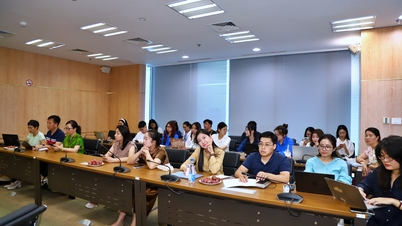
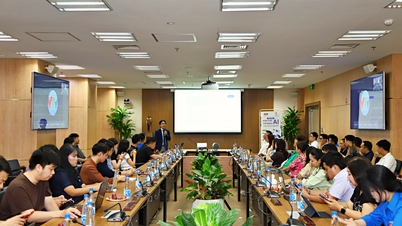
On the morning of March 15th, the People's Representatives Newspaper organized a seminar titled "Training High-Quality Human Resources: The Impetus from Resolution 57".
The seminar was organized with the aim of clarifying the meaning and impact of Resolution No. 57-NQ/TW and Resolution 193/2025/QH15 on the training of high-quality human resources.
On December 22, 2024, the Politburo issued Resolution No. 57-NQ/TW on breakthroughs in the development of science, technology, innovation, and national digital transformation to build a sustainable economy and enhance national competitiveness.
Resolution 57 is not only a guideline, but also a strong political commitment to help Vietnam seize opportunities and respond to challenges in the age of technology and digitalization.
The resolution sets out strategic goals, including promoting education and training of high-quality human resources, especially in advanced science and technology fields.
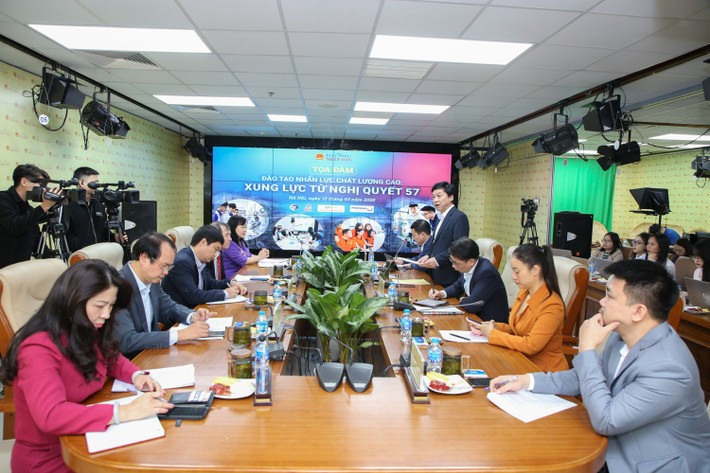
Deputy Editor-in-Chief of the People's Representatives Newspaper, Le Thanh Kim, emphasized that Resolution 57-NQ/TW of the Politburo on breakthroughs in the development of science, technology, innovation, and national digital transformation is identified as a "guiding principle" for training, providing opportunities for educational institutions to promote scientific research linked to the development of high-level scientific and technological human resources.
The goal is that by 2030, the workforce in science research, technology development, and innovation will reach 12 people per 10,000 inhabitants; there will be 40-50 science and technology organizations ranked regionally and globally; and the number of international scientific publications will increase by an average of 10% per year…
The contributions of National Assembly delegates, experts, education managers, and business representatives at the seminar have significantly helped to accelerate the implementation of policies and goals on training high-quality human resources set forth by the Party and the State.
Ho Chi Minh City to increase 10th grade enrollment quota by 5-10% in 2025.
According to information from the Ho Chi Minh City Department of Education and Training, the enrollment quota for 10th grade in public high schools in the city for the 2025-2026 school year will increase by at least 5-10% compared to the previous year, ranging from 70-80%.
According to the Ho Chi Minh City Department of Education and Training, in mid-March, after schools report their projected enrollment targets, the Department will review and assess the facilities, teachers, and development strategies of the education sector... to officially allocate enrollment targets to each school. A decision on the enrollment targets for 10th grade in the 2025-2026 school year is expected by the end of March.

This year, the students taking the 10th grade entrance exam are from the 2010 cohort, a year with a low population density, resulting in a decrease in the number of 9th-grade students compared to the previous year. It is projected that 89,649 students will graduate from lower secondary school (88,921 from the lower secondary school program, 728 from supplementary education), compared to 116,296 last year.
Furthermore, the enrollment quota for 10th grade in public schools this year will no longer be capped at 65-70% as before, but will be based on the capacity of each locality according to the Education Development Strategy to 2030, vision 2045.
According to the draft plan for 10th grade admissions in the 2025-2026 school year by the Ho Chi Minh City Department of Education and Training, students are expected to be able to register for a maximum of 8 preferences when taking the 10th grade entrance exam.
Specifically, there are 3 choices for regular 10th grade classes, 2 choices for specialized 10th grade classes, and 3 choices for integrated 10th grade classes.
The admission process is conducted in two ways: entrance examination and selection based on academic records.
Many universities are increasing tuition fees.
For the 2025-2026 academic year, many universities in Ho Chi Minh City have announced tuition fee increases, with the highest reaching 900 million VND per year per student.
Ho Chi Minh City University of Technology (HCMUT) has implemented new tuition fees for its standard, gifted, and Vietnamese-French engineering programs: 30 million VND/year; and for the Japanese-oriented program: 60 million VND/year.
Teaching in English: 80 million VND/year. International transfer to Japan: 60 million VND/year (first 2.5 years), 91 million VND/year (last 2 years in Japan) .
International transfer to Australia, the USA, and New Zealand: VND 80 million/year (first 2–2.5 years), VND 560–900 million/year (last 2–2.5 years at the partner institution).
An increase of 28–101 million VND/year compared to 2024.
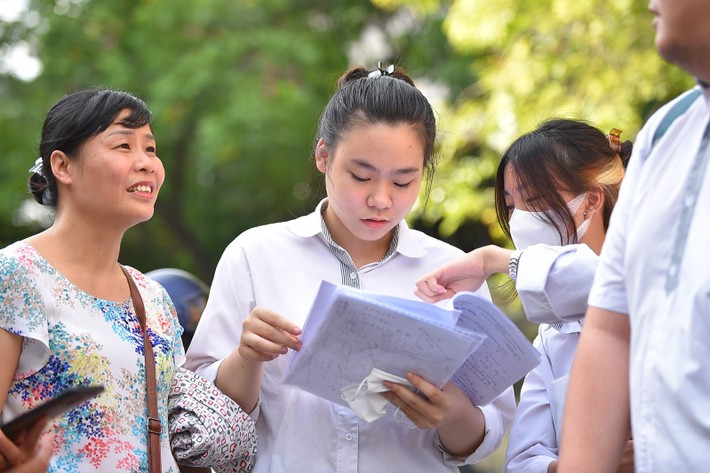
Saigon University : Tuition fees increase 1.5 times, 92–129 million VND/course for 4-year programs, 150–167 million VND/course for 4.5-year programs (applicable from the 2025 cohort, awaiting approval of the autonomy plan).
Ho Chi Minh City University of Economics has increased tuition fees by an average of 200,000 VND per credit: Vietnamese language program: 1.3 million VND/credit; English language program: 1.82 million VND/credit.
ACCA and ICAEW certificates: 1.3 million VND (Vietnamese) , 1.9 million VND (English) → Tuition fee increase not exceeding 10%/year ; Vinh Long campus is less than 40% , maximum increase of 5%/year .
Ho Chi Minh City University of Industry and Trade 's tuition fee for the 2025-2029 academic year is expected to be a maximum of 132 million VND per cohort , an increase of 12 million VND compared to the previous cohort.
Ho Chi Minh City Open University increases tuition fees by 1.5–2 million VND/year. Depending on the field: Technology – Engineering : 28.5 million VND/year
Economics – Management – Languages : 27.5 million VND/year; Social Sciences : 24 million VND/year
High-quality programs: 46.5 million VND/year , with some IT majors reaching up to 49.5 million VND/year .
A research team from Vietnam National University, Hanoi, has published research results on advanced AI chips.
The development of hardware that accelerates AI algorithms offers significant benefits, especially in the context of AI increasingly demanding high performance and high computational resource consumption. Modern AI chip models will address issues such as: improved processing speed, reduced energy consumption and increased efficiency, lower operating costs for large-scale AI, support for AI deployment on edge devices (Edge AI), and the potential for real-time AI applications.

Neuromorphic computing is considered to be significantly more energy-efficient than traditional computer architectures due to its event-driven nature. This could be a crucial future direction for improving the processing performance of artificial intelligence (AI) algorithms, especially deep learning systems.
The Intelligent Integrated Systems Research Group (SISLAB) - VNU Hanoi began researching the design of hardware to accelerate artificial neural networks in 2015 and has published numerous scientific papers on these research results.
With their Pulsed Neural Network (SNN) chip model, the research team has integrated efficient solutions to address existing challenges. The team's successful development of hardware acceleration for AI algorithms offers significant benefits, especially in the context of AI increasingly demanding high performance and high computational resource consumption.
Professor Tran Xuan Tu, Director of the Institute of Information Technology, Vietnam National University, Hanoi, and Head of the SISLAB group, shared more details about the initial results of their research on AI chips.
View the full interview with Professor Tran Xuan Tu here .


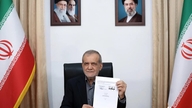
The Ministry of Education and Training has requested assistance from South Korea in compiling textbooks for teaching the Korean language.
On the afternoon of March 12, Minister of Education and Training Nguyen Kim Son received the Ambassador of South Korea to Vietnam, Mr. Choi Youngsam.
Accordingly, the Minister requested that South Korea continue to support the compilation of Korean language textbooks for the new general education curriculum, provide support for native-speaking teachers, train teachers, develop learning materials, facilitate cultural exchange, and establish sister school relationships between high schools and universities.
During the meeting, Minister of Education and Training Nguyen Kim Son and Mr. Choi Youngsam exchanged views and agreed on a number of issues and contents that both sides wished to promote cooperation in the field of education and training between Vietnam and South Korea.
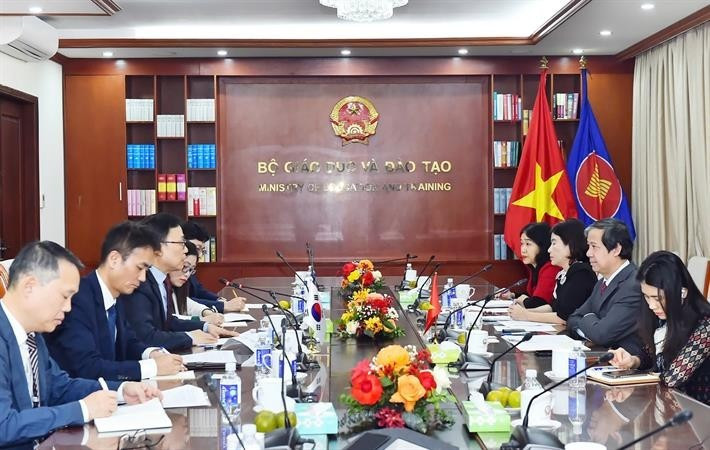
To further promote educational cooperation between Vietnam and South Korea, Ambassador Choi Youngsam requested that the Vietnamese Ministry of Education and Training pay attention to supporting the Korean Education Representative Office in Vietnam (established in 2020, with its operating period ending in November 2025) by extending its operating time to make more contributions to promoting cooperation between the two countries; continue to pay attention to the evaluation and early issuance of Korean language textbooks for teaching in primary and secondary schools in Vietnam; consider allowing Korean language certificates to be used as exemptions from the Vietnamese High School Graduation Examination; and consider supporting the continuation of some ODA projects in the field of vocational education that have been previously implemented by South Korea, with the Ministry of Labour, Invalids and Social Affairs as the focal point…
Thanking the Korean side for their cooperation in implementing the pilot Korean language teaching program in Vietnamese high schools, the Minister requested that the Korean side continue to support the compilation of Korean language textbooks according to the new general education curriculum, support native-speaking teachers, teacher training, development of learning materials, cultural exchange, and twinning between high schools and universities.
The reservation fee for admission to 10th grade at many private high schools in Hanoi can reach up to 25 million VND .
In reality, the nature of "reservation fees" is a one-time payment made at the time of enrollment, intended to secure a place. If the student enrolls, the school will deduct this amount from the annual fees. If the student does not enroll, depending on the school, parents may receive a partial, full, or no refund.
According to the People's Representatives Newspaper, the reservation fees for private high schools in Hanoi in 2025 range from 1 to 10 million VND, and in some cases even reach tens of millions of VND.
Specifically, the reservation fees for private schools in Hanoi are as follows:
| No. | School | Reservation fee |
| 1 | Archimedes School (Dong Anh) | 23 million VND |
| 2 | Luong The Vinh High School | 15 million VND |
| 3 | Hoang Mai Star School | 24 million VND |
| 4 | Newton School (K-12) | 12 million VND |
| 5 | Phenikaa Inter-level High School | 5 million VND |
| 6 | Olympia Inter-level High School | - 3.1 million VND (registration fee) - 15 million VND (reservation fee) |
| 7 | Japan International School | 25 million VND |
| 8 | Vietnam-Australia School Hanoi | - 5 million VND (SEP system) - 10.5 million VND (Cambridge system) |
| 9 | Everest Education System | 10 million VND |
| 10 | HAS Inter-level High School (Ha Dong) | 10 million VND |
| 11 | Nguyen Sieu School | 6-8 million VND |
| 12 | Sentia School | 15 million VND |
| 13 | Horizon International Bilingual School | 25 million VND |
| 14 | Brighton College | 10 million VND |
Parents, however, are divided into two camps. Some agree that a "deposit" is necessary to secure a place for their children, especially in the highly competitive race for admission to 10th grade. On the other hand, many parents argue that this fee is unfair because they are not refunded if their child does not enroll.
Source: https://daibieunhandan.vn/nhung-su-kien-giao-duc-noi-bat-tuan-qua-post407475.html